![[DOOR FLIES OPEN]](https://doorfliesopen.com/wp-content/uploads/2015/08/DFO-MC-Patch.png)

We haven’t talked a lot about imported beers in the Beer Barrel. I know, off the top of my head, that I’ve written about Czechvar and Chimay Grande Reserve and Kulmbacher Eisbock and Fullers ESB, all of which are exceptionally delicious or have exceptionally interesting stories behind them or both. But for the most part, the contents of the Beer Barrel mirror my own consumption habits, which are overwhelmingly slanted toward American beer. There are a couple of reasons for this: First of all, the American beer scene has become so rich and diverse that I rarely need to look outside it to find something new. But second, American beer doesn’t take as long to get to me, so I get it fresher, so in many cases a homegrown pilsner or witbier just tastes better than even the most acclaimed European equivalent. This is, most likely, why I consider Live Oak HefeWeizen the best hefeweizen I’ve ever had, even though German breweries have been perfecting the style for hundreds of years. But there’s something to be said for all that hard-earned expertise, too, which is why today I’m happy to be showcasing the brewer of my second-favorite hefeweizen, and a lot of other excellent beers beside: Bavarian State Brewer Weihenstephan, or Weihenstephaner for short.
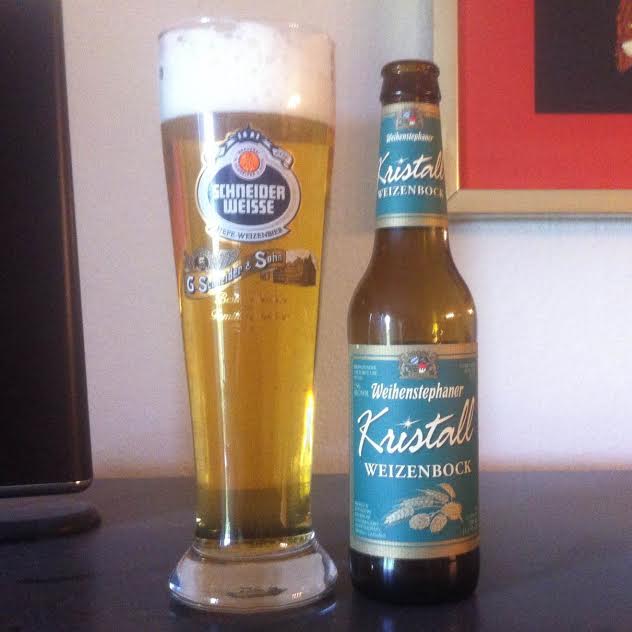
If you already know anything about Weihenstephaner, it’s probably that it’s the world’s oldest continuously operating brewery—or at least, records in 1040 A.D. being what they were, it has the strongest known claim to that title. It is also, for my money, the best German brewery, though there’s a case to be made for either Kulmbacher or Schneider. I mentioned the hefeweizen, which is excellent, but it’s not the beer I’ll be reviewing today; that’ll be their brand new limited release, which unlike many of the beers I review here should be available more or less nationwide: Weihenstaphaner Kristallweizenbock.
Germans love their compound nouns, so let’s break that one down. The core part’s the “weizen”; that’s what tells you it’s a beer brewed in substantial part with malted wheat in addition to the usual barley. “Bock” is literally “goat”—this is probably not the first time I’ve pointed that out—but it connotes a strong beer. Put those together and you’ve got weizenbock, a strong wheat beer that’s usually dark (like the most iconic German weizenbock, Schneider Aventinus), but sometimes not (like Weihenstephaner’s own Vitus, a blonde weizenbock). The one thing a weizenbock almost always is is some degree of cloudy, murky, or opaque, but: this is a kristallweizenbock, with the “krystall” portion of the name describing its clarity. The kristallweizen is pretty commonplace in German brewing, a hefeweizen filtered to remove the yeast sediment and make the beer clear. The kristallweizenbock is quite a bit rarer; I’m not sure I’d even heard of one before I spotted Weihenstephaner’s new beer on the shelf.
True to style, Weihenstephaner Kristallweizenbock pours crystal-clear, pale yellow in color, and could easily be mistaken for a pilsner by appearance. The head is tall and dense and fluffy, uneven at the top, and not going away anytime soon, from what I can tell, so I’m just going to start drinking, foam mustache be damned. A complex combination of clove, green apple, and just a bit of banana comes through immediately on both the nose and the tongue. I love what Weihenstephaner has done with the hops in this beer: They’ve used Opal, Saphir, and Smaragd (read: Emerald) for flavor, and Perle for bittering. Their commitment to the pun on “Kristall” alone probably would have been enough to win me over, but the subtly bitter finish and part-floral-part-tropical edge transform what might have been a simple, malty palate-pleaser into a well-balanced wheat ale that’s dangerously easy to keep drinking. More than that, it’s the sort of beer you can drink and feel like you’re almost having a conversation with; it’s like you can discover something new about it with ever sip. It’s the first kristallweizenbock I’ve ever had, and if it weren’t, it’d probably still be the best one.
lady snow says: Creamy. It’s a lot sweeter than I was expecting, just looking at it in the glass. It’s definitely more like what I’d expect a witbier or hefeweizen to taste like. Tastes like it should look cloudy. It’s a fruity beer, but in a different way than you’d get from a hefeweizen; still sort of a banana taste, but not quite the same.
tl;dr: It’s a wheat beer! A strong one! And it looks like a pilsner! And you can taste the hops!
Grade: The label claims this was brewed according to the German Purity Law of 1516, but actually wheat wasn’t allowed under that law until the 1600s. 0/10, you lying liars.
make it snow is an alot of beer and Posadist organizer. He drank three and a half Weihenstephaner Kristallweizenbocks while writing this review, and lady snow drank a half. The American Gods premiere was everything that either of them hoped for.














Leave a Reply
You must be logged in to post a comment.