![[DOOR FLIES OPEN]](https://doorfliesopen.com/wp-content/uploads/2015/08/DFO-MC-Patch.png)




All I know is that we need to get people working again. This is AMERICA, damnit! People need a purpose in life! They also need food. But above all else, they need to be available for my every beck and call. How am I supposed to run OTAs virtually? I can’t expect my screaming through a webcam at an overweight lineman running shuttle drills in his garage to have the same effect.
You said it, brother. Our players need to stop fearing the virus, and start fearing us again. That way, we’ll become unstoppable, just like 16th-century German mercenaries…
THE GERMAN PEASANTS’ WAR
Combatant 1: German peasants
Combatant 2: The Swabian League, mercenary armies representing German nobility
Location of Conflict: Central Europe, including Germany, Austria, and Switzerland
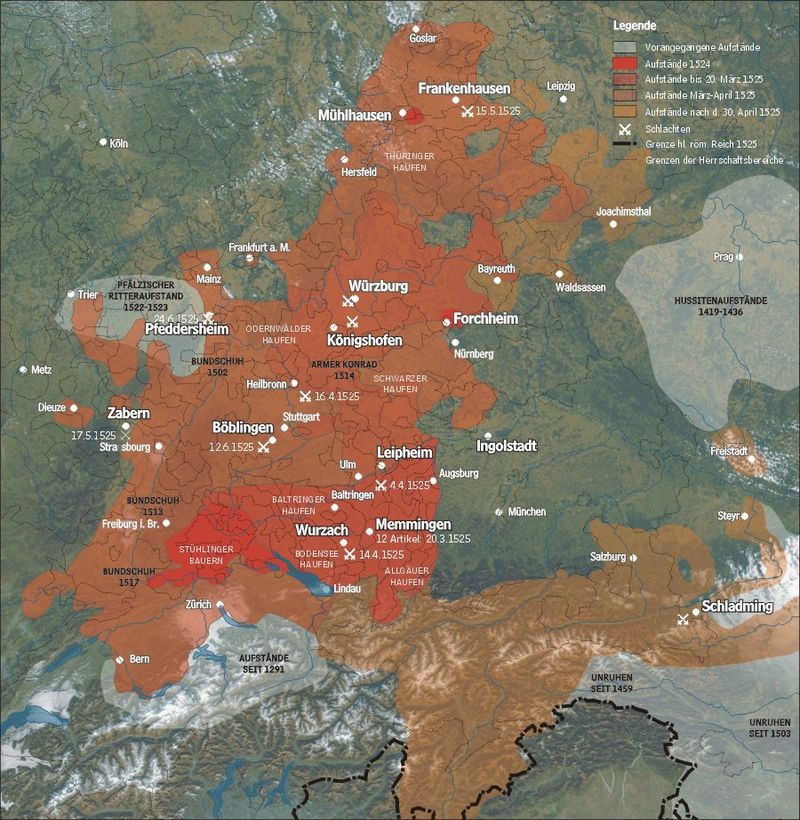
What happened? In the mid-16th century, continental Europe was in an uproar due to the Protestant Reformation, which forever fractured the power and structure the Catholic Church had on European geopolitics. Nowhere was more affected than in Germany, which faced a divide between the Holy Roman Empire, led by Catholic rulers (including the famous Habsburgs), and other smaller German principalities, each led by their own ruler of varying stripes of Christianity. The most powerful nobles, however, were closely allied with the Catholic Church and its strict, inflexible doctrine emphasizing the necessity of a social hierarchy. With Martin Luther’s kickstarting of the Reformation thanks to his 95 Theses, many lower-class people of the area began to discover a class consciousness that was previously absent. In particular, Thomas Müntzer, an Anabaptist preacher, took a strongly revolutionary stance towards the nobility, who were determined to keep the peasants down at all costs – and to keep the Catholic clergy’s coffers full. Taxation began to rise in many areas – and as has happened so many times throughout history, the brunt of these fell upon the peasants. Such ridiculous legislation passed against them included not being able hunt, fish and chop wood on common lands as they had done for hundreds of years, being forced to let nobles use their peasants’ land as they pleased, not being able to marry someone without their lord approving (and having to pay the lord a tax), and the lord receiving their best cattle, clothing, and tools upon the death of a peasant.
In 1524, things really came to a head when the Countess of Lupfen ordered her peasants to collect snail shells, for use as her personal thread spools, in the middle of the harvest season – despite the dire need to collect the crops after two substandard growing years. The peasants revolted, and raised a number of armies – one of which was led by the revolutionary preacher Müntzer.

The Aftermath: Despite having some very legitimate beefs, and lots of unified ideals, beliefs and determination, things went really, really badly for the peasants. This war was marked by brutality on both sides – the peasants, at times, acted so savagely that even Martin Luther, whose principles the revolt was largely founded on, wrote a treatise expressing his horror and shock against the peasants, whose actions he strongly condemned.
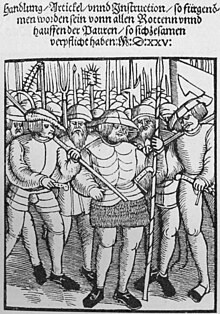
By mid-June 1525, the war was essentially won by the Swabian League, and by September, the insurrection was officially over. In just over 12 months, over 100,000 peasants were killed at the hands of the mercenary armies, thoroughly entrenching the strength and power of the nobility for centuries to come. Not until the 19th century would Germany see another large-scale class uprising, as the lessons learned by the peasants from their defeat over three centuries earlier still resonated with the populace.
Things were definitely bad for the peasants, but the real lesson from this conflict should be for the nobility: don’t ask your peasants to collect snail shells for you. It makes them very mad.
If you ask me, Jim, the problem with the peasants was that their anger was misdirected. They shouldn’t have been pissed off at the nobles – they should have been pissed off at the lack of cleared land. Hard to play football when you’re in the middle of a forest.
And to be fair, the nobles needed to understand this better, themselves… wars are inherently counterproductive. Much easier and cheaper to clear a bunch of trees and paint some yard lines – and if you get beat fair and square on the gridiron, so be it. The peasants missed their shot at an upset Super Bowl victory, if you ask me.
***
Information for this article taken from here, here, here and here. Banner image by The Maestro.








Leave a Reply
You must be logged in to post a comment.