![[DOOR FLIES OPEN]](https://doorfliesopen.com/wp-content/uploads/2015/08/DFO-MC-Patch.png)

It’s funny, when you think about it: German brewing culture, in some form or other, has dominated the mainstream American beer landscape for, what, a century or so? German immigrants brought lager to America in the 1830s and 40s, and by 1857, lager beers were outselling the previously dominant English-derived ales. Today, we see the descendents of German-style (and the closely related Czech-style) lagers all around us: Not just the core Anheuser-Busch and Miller brands, but Pabst and Stroh’s and Hamm’s and, oh, look, Yuengling Lager is also here.
So why the hell is craft beer today so thoroughly English? Why is it that every new brewery these days starts, not with a pilsner and a schwarzbier, but with an IPA and a stout? The biggest reason’s probably cost: Lagers are a huge part of German beer, and they’ve got to be stored cold during fermentation, occupying time and space a brewery could be using to brew, bottle and ship a new batch of IPA every two weeks. The shortage of good American German-style wheat beers is a little harder to explain, though. Sure, plenty of breweries in this country put out a “hefeweizen,” usually a characterless pale yellow wheat beer that’s a disgrace to the name. The real shame, though, is that almost no one even bothers with one of my favorite styles: The weizenbock, the chocolate banana milkshake of beers. The weizenbock is a wonderful, warming, filling beer and, in this alot’s opinion, the most perfect of winter beers.
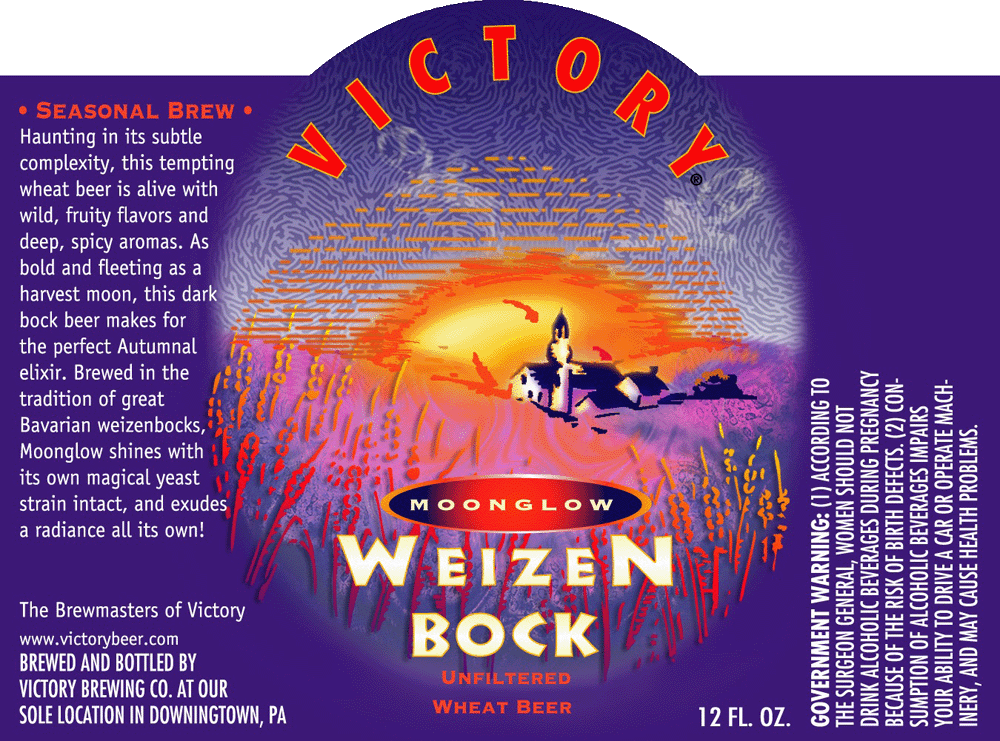
There are, though, it turns out, a handful of American craft brewers committed to making German styles. It wouldn’t do to ignore, of course, the fact that the most popular craft beer in the country is Boston Beer Company’s Vienna lager, or that the best-selling craft beer in Texas is Shiner Bock. And then, of course, there’s Victory Brewing Company of Downington, Pennsylvania; a brewery notable more than anything for producing a pilsner that doesn’t taste like stale air. Their seasonal weizenbock, it turns out, is also good.
The paradigmatic German weizenbock is Schneider Aventinus, a dark, muddy, and crazy rich beer. A personal favorite of mine is Weihenstephaner Vitus, a strong blonde beer that’s like an explosion of fruit flavors despite a minimal hop influence. Our beer du jour, Victory Moonglow, splits the difference, pouring a handsome golden brown with a large fluffy head. It’s noticeably clearer than your average weizenbock, which will tend to be relatively opaque with suspended yeast. There’s not a lot of room for inventiveness in a traditional weizenbock, and this one follows the blueprint faithfully. If there’s a flavor the German weizen yeast produces without fail, it’s that of bananas, and that’s at the forefront here. It’s balanced by some semisweet chiocolate, a touch of clove, and a bit of roast. At 8.7% ABV, it’ll hit you hard in a hurry, but it tastes like a beer maybe half as strong.
lady snow says: It tastes like a harvest. It tastes like what you would want to drink after a long day harvesting in the fields, and you have a dance afterward? This is what you would drink at that dance.
tl;dr: I’ve yet to find a brewer, other than maybe Austin’s own Live Oak, that makes a weizenbock truly on par with the original German offerings. But on a cost-per-ounce basis, this is a great way to satisfy your weizenbock cravings or curiosity; you’ll pay five bucks or so for a single pint bottle of Aventinus, where this comes at nine bucks or so for a four-pack.
Grade: Do not buttchug this. It’s like shoving a banana split up your ass, it’ll get you drunk, but… wait. Bad comparison. But don’t. Your butt doesn’t have taste buds, is what I’m saying.
Bonus mini-review: I’ve talked a lot about “traditional” weizenbock above. If you want a weizenbock that’s not traditional but that is delicious, Brooklyn Brewery collaborated with Schneider on a hop-forward weizenbock, Hopfenweisse, that I can’t recommend highly enough to the sufficiently adventurous drinker.
make it snow is an alot of beer. He drank one bottle of Victory Moonglow Weizenbock last night, and three more today to make sure. He’s not thrilled with this 21-0 Michigan lead.
In writing this review I relied on work from Serious Eats beer historian Lisa Grimm, which can be found here.


Leave a Reply
You must be logged in to post a comment.