![[DOOR FLIES OPEN]](https://doorfliesopen.com/wp-content/uploads/2015/08/DFO-MC-Patch.png)

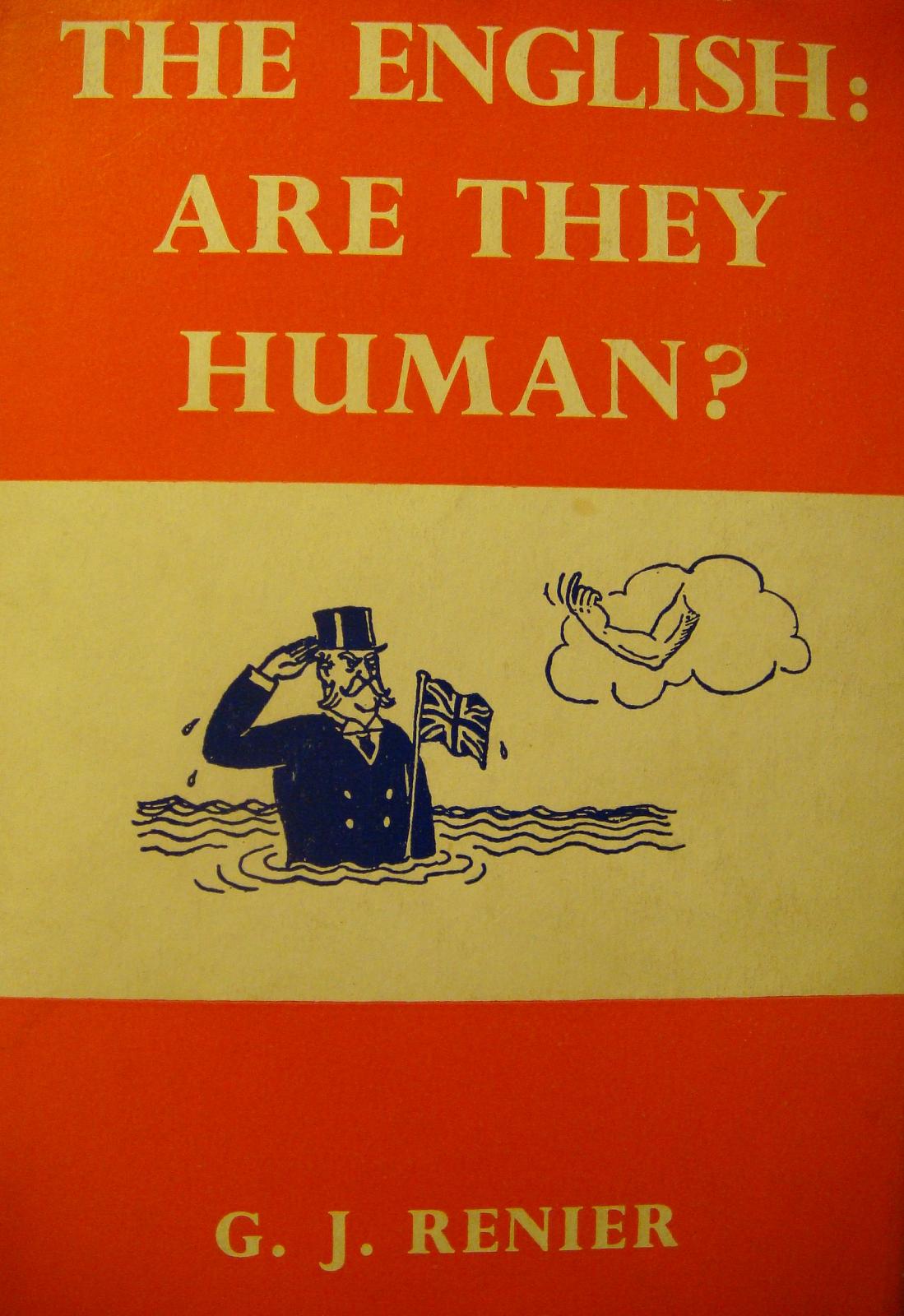
Despite controlling one-third of the world’s landmass and one-quarter of its population at its peak in the late 19th century, one really has to wonder if the English are even civilized in the first place. As Indian historian and MP Dr. Shashi Tharoor stated in a 2015 speech at Oxford University, “No wonder the sun never set on the British Empire… even God couldn’t trust the English in the dark.”
In G.J. Renier’s The English: Are They Human?, the author sets out to examine why the English are the way they are; it’s not an easy task. Despite the title being absolutely hilarious, the book itself is somewhat humorous, but overall quite academic. This, to me, is quite disappointing. Thus, I am setting out to improve upon his work, and find some case studies that properly shed light on what makes the English such an absurd people. Fortunately, there’s so much out there to choose from. After careful research, it is my conclusion that the English cannot be considered human.
Why?
Well, they really liked to dress up corpses for photo shoots with the whole family.
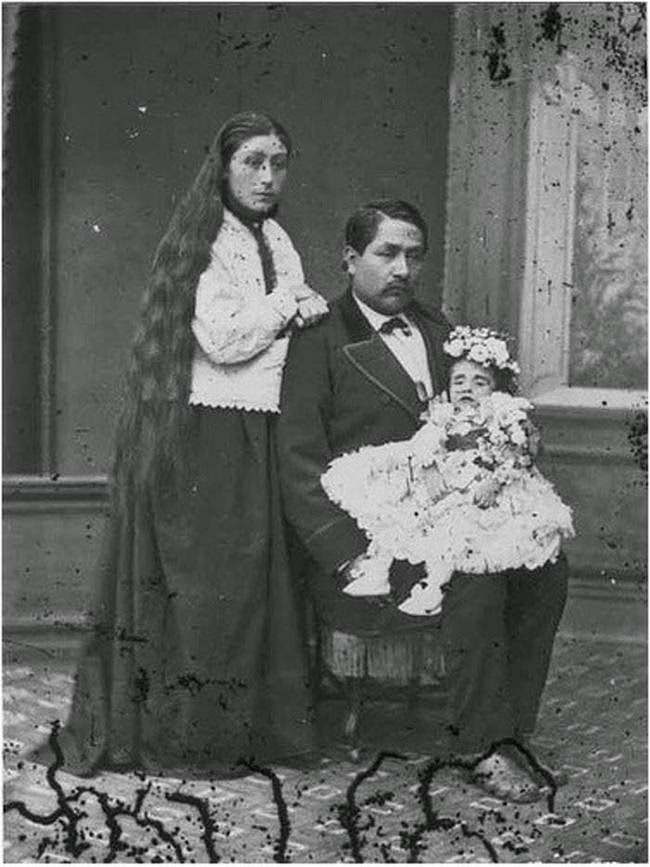
THE VICTORIAN ART OF DEATH PHOTOGRAPHY
Date: Mid-19th century
Location: All of Victorian England (and much of the rest of the British Empire)
As Charles Dickens and I have both shown in our myriad writings, Victorian England was a desperate time for the many millions of people struggling to keep up with a rapidly-changing way of life. With industrialization sweeping the globe, people had to quickly adapt in order to survive – even if it meant taking on dangerous, grossly-underpaying jobs, and living in tiny, cramped, freezing, and filthy living conditions. Indeed, many English subjects lived fast and died young in this era. With families hardly having any time to mourn, due to the necessities of society that they were swept up in, they had to get creative in order to keep memories alive.
Enter the wonderful new invention of the daguerreotype photograph. Invented by Louis Daguerre, a Frenchman, in 1839, the prospect of quickly-developing photographs, for the first time in history, allowed families to preserve visuals of their loved ones for time immemorial. Early photographs used a shiny silver-plated slate of copper placed in a camera, sprayed with mercury fumes, exposed it to light for however long was deemed necessary for a good image. While rudimentary and expensive for its time, it remained far, far cheaper and much less time-consuming than sitting for a portrait. By 1860, advances in technology made the process much faster and cheaper, and thus for the first time, photographs were available for creation and purchase by the general population.

With many English cities so thoroughly dreadful in this time – rife with disease, smog, crime, and poverty – it was no wonder that life and death continuously walked hand in hand as dear companions. That’s not to say it was ever any easier for our Victorian counterparts to handle death, as compared to what we face today – but at least with death’s constant presence in life, it stirred something in society that made it necessary to occasionally blur the lines between the two in order to rationalize it all. Memento mori has existed across the world in many societies for thousands of years, but with new technology available for the first time, it would evolve once again.
Of course, let’s not forget that the English are not human. The solution they arrived on was, naturally, completely ludicrous.
Why not dress the dead up and strap them upright in a chair to make it seem like they’re still alive? Better yet, why not get whole families – including extremely young, impressionable children – to pose with the deceased and pretend like it’s all OK?
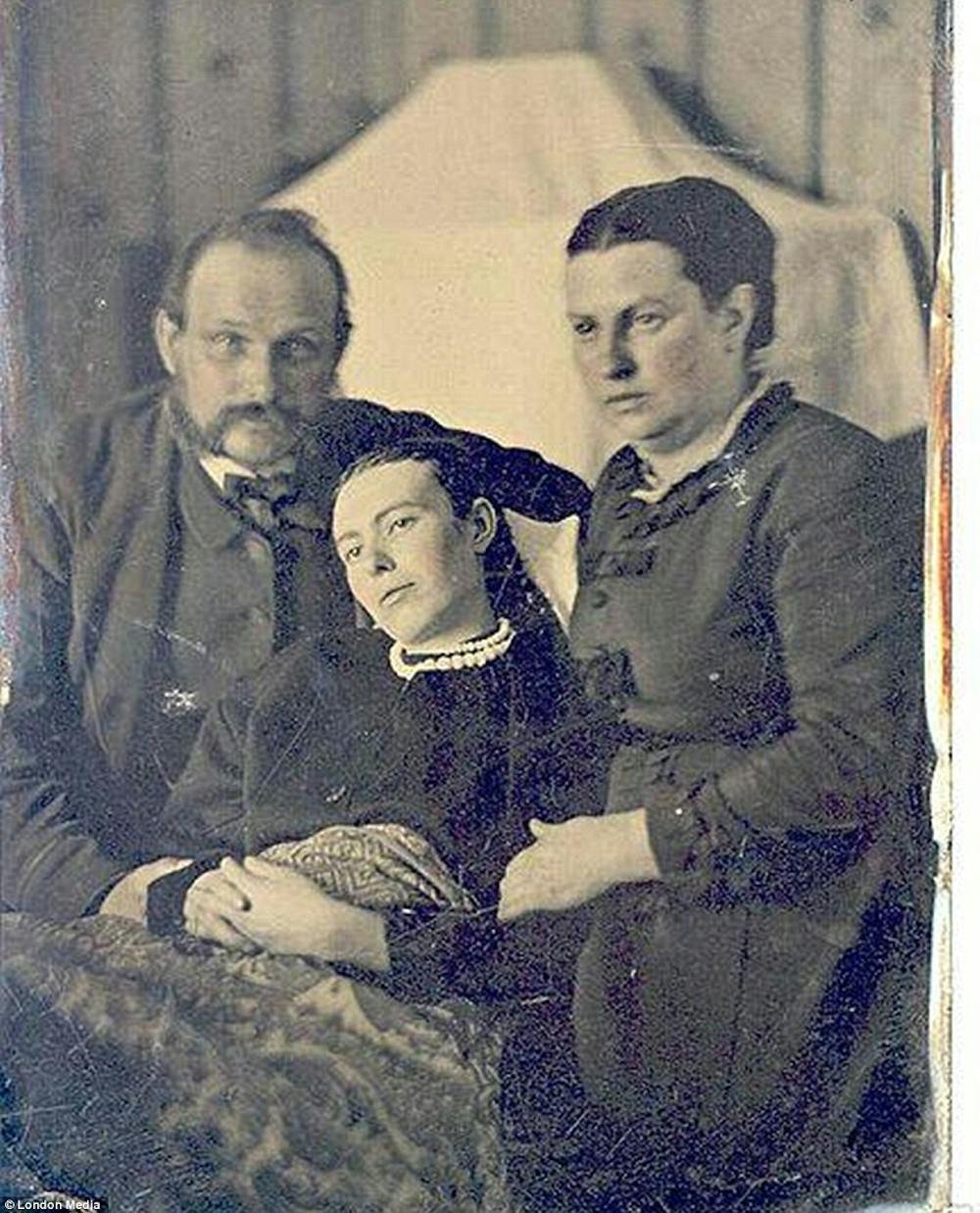
This was an everyday occurrence in English society through the latter half of the 19th century. Queen Victoria lost her husband, Prince Albert, to typhus in 1861, and spent the remaining fifty years of her life in mourning, never appearing in public wearing anything but black. With the monarch so beloved, a societal obsession with death made perfect sense for the era.
What’s especially freaky about Victorian memento mori is that due to the limitations of the technology – specifically, the long exposure times required to get a good image on the plate – the nature of the deceased is not always readily apparent. Besides corpses being very heavily made up and dressed to the nines, of course, the softness of the lines from the imperfect nature of daguerreotype photographs can sometimes bestow the subject with those last few fleeting moments of life that modern technology can’t possibly accomplish, due to its accuracy and precision.
Look at this shit. These kids are fucking scarred. Therapy? Forget it. That’s for civilized societies.

By the end of Victoria’s reign in 1901, the practise of death photography was on the wane, largely thanks to improvements in photography technology. The ability to take snapshots – photographs that didn’t require the careful motionless posing and long exposure times of daguerreotypes and other similar methods – meant that it was now possible for families to have more candid shots of their loved ones, including from when they were still alive. In this era of instantaneous digital photography, it’s hard to imagine that memento mori in the form of death photography will ever again make a serious resurgence – but let’s not count the English out just yet. Anyone who think it’s a good idea to expose their families to corpses, especially those that might have still been contagious, just for the sake of art, is probably not human.
***
Information for this article taken from here, here, here, and here.






Leave a Reply
You must be logged in to post a comment.