![[DOOR FLIES OPEN]](https://doorfliesopen.com/wp-content/uploads/2015/08/DFO-MC-Patch.png)

[I’d like to thank yeah right for starting the book articles going, and apologies for changing up the article naming convention, but I couldn’t resist]
Have you ever been to some sort of festival or concert filled with hippies and their kids (*coughcoughCUNTLERcoughcough*), or seen some picture of people with kids at Burning Man, and wondered what it would be like to be that kid? What would it be like to grow up with such free spirits taking care of you, especially if you fall in the lowest economic class? How would you handle sudden disasters that take everything away if you can’t rely on your parents to take the lead? How would it affect your life as you grew into adolescence and adulthood? And what if your sole parent was slowly dying?
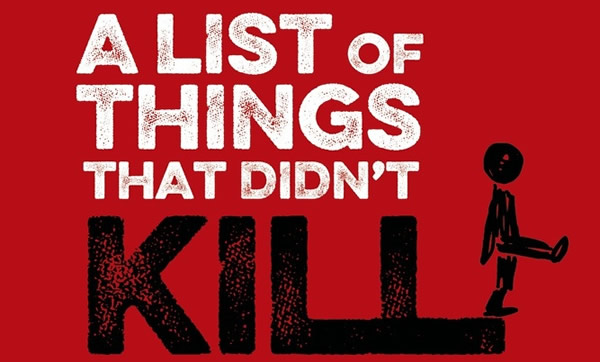
Jason Schmidt’s excellent autobiographical book A List Of Things That Didn’t Kill Me may help provide some illumination on those questions. He was born to parents living on the fringe of hippie society in 70s–his mom soon left the family due to mental illness, and one of his earliest memories involved his dad being arrested for dealing drugs. The author makes an interesting distinction of the free-love middle class hippies that were around them–but not quite their people–and the poor, “white trash” hippie culture they belonged to. They weren’t part of the “straights” and weren’t part of the popular counterculture, either–no matter what, he was going to grow up different.
He also grows up at a very interesting time in our recent history, as hater, his dad–his sole caretaker–contracts HIV/AIDS at a time when there was barely a name for it. He crossed from childhood to adolescence in late 70s/early 80s Capitol Hill in Seattle, watching his dad’s friends waste away from a misunderstood and frightening disease that is being ignored by the establishment. It’s a striking look, even if it’s only part of the periphery, of a place and time sometimes forgotten today after years of amazing progress.
While this is classified as a “young adult” book, it has an incredible amount of layers. Jason’s father is not simply neglectful, but abusive as well. This abuse is not always brought to the forefront as much as the effects of it are on a developing psyche. The most chilling parts, to me, was how his father could instill doubt in him that the abuse was even happening–after all, when you are solely dependent on this person for practically everything in your life, you tend to base your sense of ‘normal’ off of whatever they may say and do. It’s insidious, but also illuminating.
Jason writes it very well, and if I had to give it any criticism, is that it ends too soon and too abruptly. It’s still an effective ending, and made me want to learn more about who he is today. It’s a complex story, but entirely believable thanks to his lack of embellishment and brutal honesty–reading about him self-destructing socially are some of the most cringe-inducing passages in the book, which is saying quite a bit.
On a readability scale of 1-10 with 10 being highest, I give this an 9.
It’s a challenging read not because of the words, but because of the important and heartbreaking issues it tackles and the straightforward manner in which it presents them. It reads fast and you won’t want to put it down, especially if you ever grew up different in any way.


Leave a Reply
You must be logged in to post a comment.