![[DOOR FLIES OPEN]](https://doorfliesopen.com/wp-content/uploads/2015/08/DFO-MC-Patch.png)


When it comes to offensive playcalling, I don’t like risk! That’s why when it’s windy outside, it’s always better to elect to kick. In other news, I’m still waiting to get calls about open head coaching positions, but I’m certain that things are gonna happen soon for me! A positive attitude is key – I’m sure there’s a high school or D3 team in need of some solid fundamentals. I’m not picky – I just wanna coach, and coach safe! That’s why this week’s weapon isn’t a particularly appealing one to me…
THE STICKY GRENADE
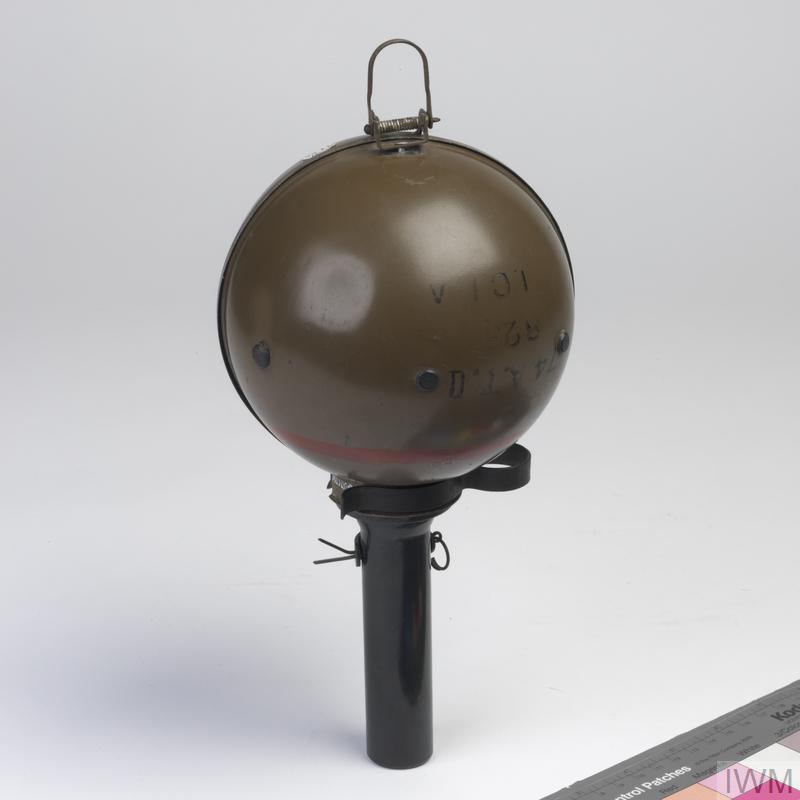
Purpose built: Inexpensive, portable anti-tank weapon
Years used: 1940-1943
What is it? In an effort to try and quell the threat of an impending Nazi ground invasion to the British Isles at the start of 1940, the British Army worked to develop an easy-to-use, low-cost anti-tank weapon that might perhaps prove to be useful against the growing numbers of German Panzer tanks being massed in France. Due to anti-tank guns and ammunition having been abandoned in France in the hasty evacuation of Dunkirk, the British Army was left without much in the way of traditional anti-tank weaponry, which is why they were so determined to develop alternative, unusual methods. The No. 74 sticky grenade, or sticky bomb, was a fairly simple design; it was a 560-gram sphere of a viscous nitroglycerin-based explosive gel, which was protected by a metal casing that fell away when a pin was pulled. The sphere was coated in an adhesive gel made from birdlime that allowed it to attach to metal surfaces, which was connected to a wooden handle. When a second pin was pulled in the wooden handle, the fuse was lit, giving the user five seconds until the gel ignited and then exploded.
After extensive testing by the British Army and Home Guard, top military brass still didn’t feel the weapon was ready for full-time usage – until Prime Minister Churchill personally intervened to keep the project alive. All in all, about 2.5 million of these things were produced – they saw use by the British Army in Italy and North Africa, and by ANZAC forces in New Guinea. Even the French Resistance got their hands on a few. Despite the high number of sticky grenades produced, they were still highly unpopular, and were it not for Churchill’s direct orders, it’s likely they never would have been used at all.
Why didn’t it work?
- The adhesive on the grenade would not allow it to stick to any surface with even a tiny bit of dust, dirt or mud – making it a highly unsuitable weapon for actual combat usage.
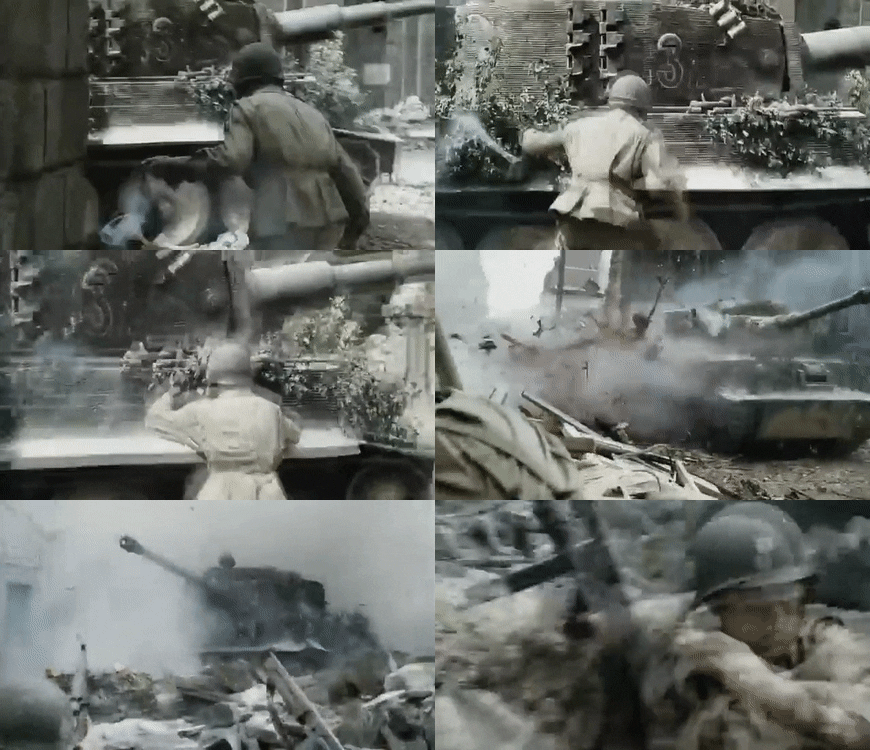
- Actual instructional usage dictated that it had to be placed on the tank or target in question; the grenade could not be thrown from any distance due to unpredictability. So, yeah, imagine having to literally run up to a tank, activate the grenade, and then run away. All without getting shot at or blown up.
- While the adhesive wasn’t particularly effective on metal surfaces… it did stick like crazy to fabric. Specifically, to soldiers’ uniforms.
Here’s a quick YouTube video on the develop of the sticky bomb which you can check out.
What could make it better?
- Improved adhesive ability;
- Ability to be thrown/launched from a greater distance with accuracy and predictability;
- A propensity to not stick to clothing or skin.
- The Nazis had a sticky bomb design of their own, which used magnets to stick to the metallic target; this seemed to be a much easier way to control the weapon, though its usage was still also limited at best (see the above video for a demonstration).
Despite this insane idea, which resulted in a number of soldiers likely shitting their pants upon or immediately after using said weapon, the Allies did manage to claim six German tanks in the North Africa campaign as a result of the sticky grenade. I’m not sure the astronomical laundry bills ended up making it worth it, however. Needless to say, there’s a reason that this design hasn’t been repurposed into an effective modern era – at the end of the day, it’s still basically unusable. Isn’t champagne a wonderful thing for helping to make life-and-death decisions?




Leave a Reply
You must be logged in to post a comment.