![[DOOR FLIES OPEN]](https://doorfliesopen.com/wp-content/uploads/2015/08/DFO-MC-Patch.png)

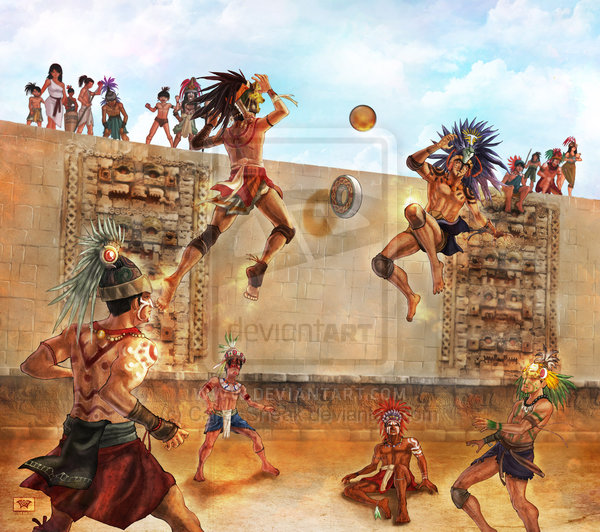
I’m breaking one of my rules this week: this edition of This Week In Violence! explores a sport that is no longer practised anymore. I’d say this is a shame, except the reality now is that recruiting top athletes would probably be quite difficult, considering the whole, y’know, extremely regular death thing. Today, we’re going to discuss the ancient ball game of Mesoamerica!
The Mesoamerican ball game has a number of different names, including el juego de la pelota in Spanish, ōllamaliztli in Nahuatl, and pitz in classical Mayan (probably the best-known name). A modern version of the game known as ulama also exists today, with much of its gameplay taken from its historic ancestor.
Pitz was played all over Central America; intricate stone ball courts have been found in hundreds of locations from as far south as Nicaragua to as far north as Arizona. Historians aren’t sure of its origins, but some hypotheses believe it to be originally from the Olmec civilization’s homeland of the Isthmus of Tehuantepec (at the southern end of the Gulf of Mexico), or possibly the Paso de la Amada, (further south past the Yucatan peninsula in the Chiapas region on the Pacific side of Mexico), closer to the border with Guatemala. This site is of particular interest to archaelogists and historians, as it was home to the oldest ball court found to date, sourced to around 1400 BC.

As such, it’s believed that pitz played an integral role in the life of almost all citizens of Mesoamerica, up until probably around the sixteenth century AD… which, remarkably, is when the Spanish first showed up… hmm…
The ball courts in question found in archaeological ruins are not uniform in size, though their layout does remain fairly standard, even across such a wide geographical area. Still, all courts have a long narrow alley, surrounded by steeply sloped and horizontal (and in some rare occurrences, vertical) walls. The largest court, found at Chichen Itza, is 96.5 m long by 30 m wide; it’s believed to have been one of the most prominent in the entire region.

The rules in question aren’t really known to us in the modern day, though it’s believed to be somewhat similar to a game like racquetball or squash, where the ball has to be kept in play. Based on evidence, it’s believed that two teams of 2-4 players each face off against each other, likely kept the ball up in the air while bouncing it off the walls, and if it dropped, their opponents scored a point. Some courts also had hoops on the walls, though it’s not clear if they were part of the rules of the game or merely just for ceremony, as some were placed so high up on the wall that it likely would have been extremely difficult to put the ball through the hoop.
The ball in question was made of rubber, common to many regions of Mexico, typically about 10-12 inches in diameter and could weigh anywhere from 3 to 6 pounds; not surprisingly, when these got up to high speed, players regularly got hurt and even killed by the fast-flying projectile. Bruises and broken bones were probably very common features of the game. Players also didn’t wear much in the way of protective gear; most of the time, it was simply headdresses, leather girdles and sometimes gloves, though we only know this through art found on archaeological sites, as none of the gear or costumes have survived into the modern age. Other rules tend to change depending on geography, but it appears as though players predominantly hit the ball using only their hips, although apparently some evidence exists of versions where players used their arms, hands, legs, or even small bats or rackets.
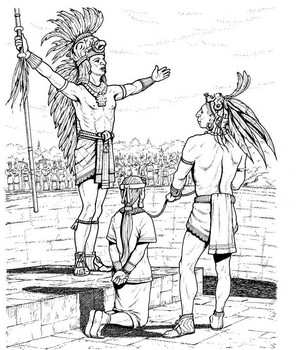
All this said, there is, of course, the element of human sacrifice as well in the game. While this wasn’t a practise done everywhere, there’s still enough evidence based on murals found on ball court walls that it was still common in many areas. However, the nature of the sacrifices is also still debated among historians; to date, nobody’s quite clear on whether it’s a bunch of slaves or captives that were part of a wager between sides that were sacrificed, or whether the losing team (or captain) were the unlucky victims instead. Some people have postulated that it may even have been the winning team that got sacrificed, for some crazy-ass reason that makes no sense to me.
Pitz was not only sport, but political discourse as well; it was played by common folk, all the way up to nobility and kings, and at its highest levels could be a way to settle disputes between neighbours without having to resort to all-out warfare. It was also a symbol of class structure of Mesoamerica at this time, as winning teams and players were highly regarded and revered as well, most likely. The Aztecs likely played this game for religious significance as well, making it an integral of many cultures of Central America in the pre-Columbian years.
So all in all, it was probably a hoot to watch, but likely more so if you didn’t have any family or friends’ lives at stake over the outcome of the match. You can check out a recreation here, if you want to see more.
Here’s a cartoonized version from The Road to El Dorado, the kids’ movie from 2000, that, surprisingly, is also a pretty good version (and funny, though it’s midnight and I’m currently exhausted while writing this thing.)
If anyone feels like going through ruptured organs and traumatic internal haemorrhaging, though… this is your surefire way to achieve both in the most entertaining way possible for those watching!






Leave a Reply
You must be logged in to post a comment.