![[DOOR FLIES OPEN]](https://doorfliesopen.com/wp-content/uploads/2015/08/DFO-MC-Patch.png)

Seems like it’s getting harder and harder to fill out my roster for next fall’s high school football team. I wish I’d be able to make the jump back to the NFL soon, but for whatever reason, seems like nobody’s answering my texts these days. Kind of a bummer, so I’ve turned my attention towards the school season starting in August. We had the incoming freshmen in to take a tour of the school and meet with teachers and coaches, and you know what? They’re TINY. It sucks! They need to get some growing done over the next few months! I miss the good ol’ days, when ninth-graders were nine feet tall and could pick their fathers up over their heads. That’s the way football should be played. Same with warfare. Enough of all this piddly “strategy” stuff – just get big, and HAMMER your opponent until they submit. That’s why this week’s weapon is one of my all-time faves!
THE SCHWERER GUSTAV
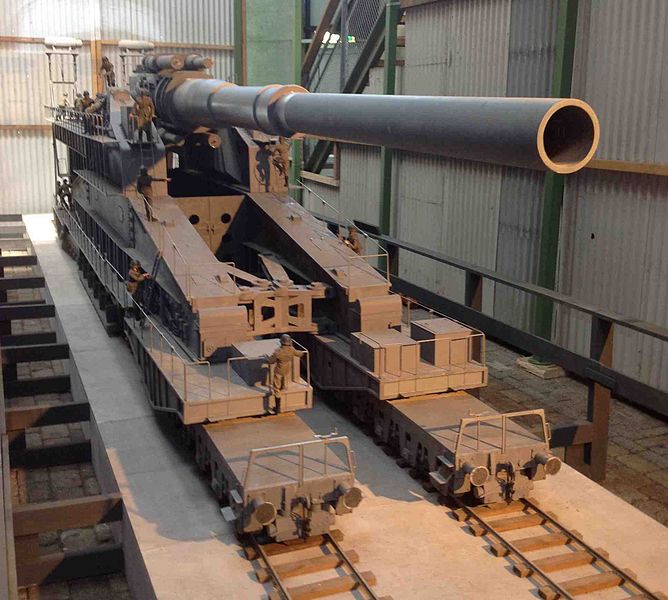
Purpose built: To destroy the French Maginot Line, the Russian city of Sevastopol, and anything else that happened to be adjacent
Years used: 1934 – 1945
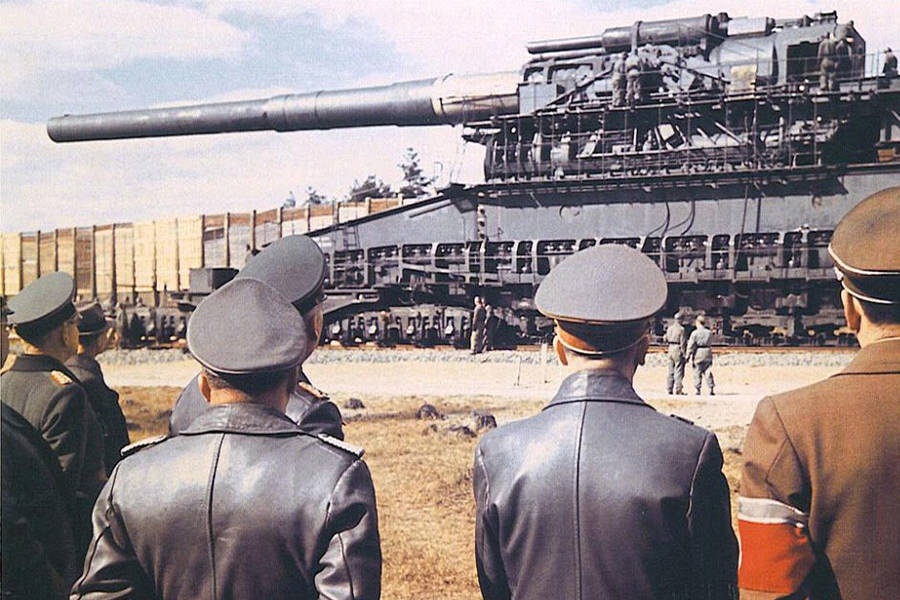
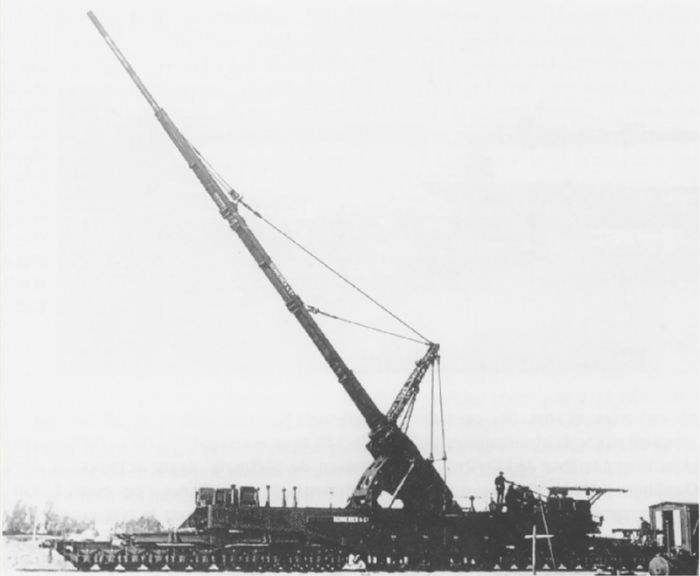
What is it? The biggest goddamn gun in the history of the goddamn world, that’s what. Nazi Germany, with a leader whose territorial ambitions amounted to, essentially, a genocidal dick-measuring contest against other global heads of state, naturally invented this thing. Starting in 1934, the Krupp industrial design company was working on a railway-mounted gun; by placing it on directly on the tracks, it allowed for the Wehrmacht to make it much more mobile than it otherwise might have been. This was a stroke of brilliance, because the size of the gun (38 feet high, 23 feet wide, 155 feet long – with a 106-foot barrel, weighing a total of 1350 tonnes) was unlike anything that humanity had ever seen previously. Its 80 centimeter caliber shells were also the third-largest in history, bested only by the British “Mallet’s Mortar” and American “Little David” (both 36 inches/91.5 centimeter caliber) – but unlike their enemies’ designs, the Schwerer Gustav was the only one ever used in combat. The 4.7-ton high explosive shells could be used at a range of just over 29 miles, while the heavier 7-ton concrete-piercing shells had a maximum range of 23 miles.
After getting approval for a final version in 1937, the first of two guns was delivered to the Wehrmacht in 1941. It received the nickname “Schwerer Gustav” (“Heavy Gustav”) after the director of the Krupp company, Gustav Krupp von Bohlen und Halbach. While initial intentions had been for the gun to be used to help destroy the stationary fortifications of the Maginot Line, partly lining France’s border with Germany, the Nazis had already succeeded in conquering Western Europe by this point, and decided to send it eastwards instead. During the siege of Sevastopol, the Schwerer Gustav was deployed from 15 kilometres away to hit critical targets, while the second gun of the same size, named Dora, was poised to be used during the siege of Stalingrad later in 1942. Unfortunately for the Nazis, the tide was turning, and the gun was never used. In the German retreat through eastern Europe, Schwerer Gustav and Dora both came along, but in the late days of the war, both guns were destroyed to prevent them falling into Allied hands. The Soviets, however, found the remains of the first gun, and studied them extensively in the days immediately following the end of the war, while the Americans found the remains of the second, which they didn’t scrap until the early 1950s.
- It required 2000 people to fire the Schwerer Gustav – the majority of those were to provide adequate air cover and support for deployment, but it still took 500 men to load and fire the gun.
- Because the gun was so insanely large, it required parallel sets of railroad tracks in order to move it into position; because these typically had to be constructed before the gun could be placed in its final position, it made it much easier for reconnaissance teams to determine where the Wehrmacht was planning on deploying it – it was very hard to disguise building these tracks, especially from the air.
- It took five weeks to get the gun in position to fire on Sevastopol; besides the typical 2000 personnel required to fire the gun and provide covering fire for its use, an additional 2000 personnel were also needed to build the tracks and defend the area required to actually put the gun where it was intended to go.
- The barrel could not be swivelled left and right – it could only be fired straight-on, due to its design. In order to adjust the direction of the barrel, the gun had to be positioned on a curved section of track in order to change the way the gun pointed – making it an even longer and more difficult job to calibrate the weapon.
- It took between 30 to 45 minutes to fire, clean and re-load the gun, meaning that it could only be used upwards of 14 times in a single day.
- The barrel of Schwerer Gustav got worn out after fewer than 300 uses, requiring a difficult and expensive retrofit.
- Overall, the cost of the gun was just too expensive for continued use; while the first was free to the army, the second one, named Dora, came at a cost of seven million Reichsmarks, which works out to be roughly equivalent to $24 million USD in 2015 figures.
What could make it better?
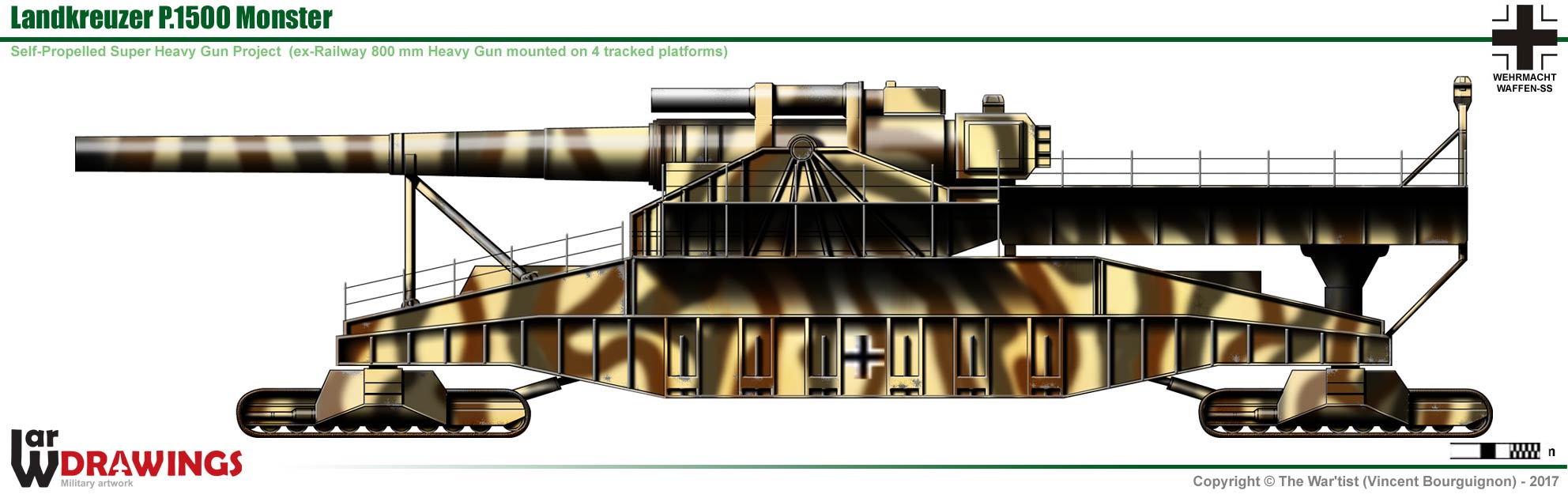
Well, as you all know by now, I’m all about risk management, whether it’s on the football field or on the battlefield. That’s why I love the fullback draw in high school football – you just get your biggest guy to get rumbling, and nobody can stop him. You know what the issue was with this gun? It just wasn’t big enough. It should have been a mobile fortress, if anything. The Germans actually did have this idea, as well – a concept design known as the Landkreuzer P. 1500 Monster, a 1500-ton self-propelled artillery gun running on four U-boat diesel engines, with a crew of 100, that was unfortunately never built.
Information for this article taken from here, here, here, here and here. Banner image by The Maestro.



Leave a Reply
You must be logged in to post a comment.