![[DOOR FLIES OPEN]](https://doorfliesopen.com/wp-content/uploads/2015/08/DFO-MC-Patch.png)

A quick, partially on-topic aside before I start: if you can, catch the two anthem performances from the NBA All Star game in Toronto Sunday. Ne-Yo absolutely ruled the US anthem. For a guy who I thought was just auto-tune and better writers turned in a performance worthy of comparison to GaGa’s at the Super Bowl. Then Nelly Furtado produced the single worst rendition ever sung by a Canadian. It was Carl Lewis bad. It was a goddamned national embarrassment, broadcast across North America and around the basketball-watching world, and I hope it kills her career (although given CanCon regulations, she’ll still get airplay & residuals).
Oh fuck; my ears!
This is especially aggravating to me because today – February 15th – is Flag Day in Canada, and I’ve spent a week preparing a lesson for my students that a rendition of the anthem like Furtado’s ruins, because all the kids want to talk about is why their twitter feeds say she’s a national embarrassment. [FYI: we are in school today because BC, in its wisdom, decided to have its February holiday a week before the rest of the country and the US.] So, I spent the better part of the first hour of the school day showing YouTube clips of other bad versions, but forgiving those people because at least those people were American and had never heard or sung the Canadian anthem before.
Here’s the former gold standard of awful.
So, to coincide with 2016 being the “Year of BLEERGH”™, I’m sharing with my fellow Commentists what my students got to hear & discuss this morning.
Canada’s Flag Day is February 15th. As with most things Canadian, the change is not the result of war or an incident of historical significance, but of tedious discussion & debate around what the “nation” was at that time.
Canada’s centennial of independence from Britain was due in 1967. In advance of that date, a number of politicians thought about upgrading certain national symbols and institutions to reflect the country’s growth out of colonial status. However, as befitting the changing of such an important national symbol, a discussion about national symbols turned into a debate about the national and ethnic identity of the country as a whole.

The old flag clearly represented British heritage. Canada had fought two World Wars under those colonial colours, and there was a natural hesitation among those of British heritage to “abandon” the monarchy by amending the flag. At the same time, the major world powers that Canada saw itself as equal to only considered Canada as an appendage of Great Britain. The US only recognized Canadian independence in 1927 – after Britain announced through the Balfour Declaration that its “dominions” were able to create their own, independent foreign policy – and only considered Canada worthy of “embassy status” in 1943, in advance of the Quebec Conference. Even until the late-1980s, the branch of the US State Department that handled Canadian relations was also responsible for monitoring British overseas colonies. The Prime Minister of the day, Lester B. Pearson, saw the updating of national symbols as a way to make a symbolic advance on the world stage. Since he was from the Liberal Party, and they had a significant portion of their MPs from Quebec, some saw Pearson’s move as a sop to the non-British wing of the party.

During this same era, nationalism was beginning to emerge as a political force in Quebec. The 1960s were a time of ethnic unrest among minority populations around the world, and for a significant portion of Quebec’s population, there burns the constant desire to create their own country. A separatist premier (i.e. – equivalent of a US governor) of Quebec, a man named Rene Levesque, once called Quebec a “French lifeboat surrounded by an English sea”. He intended to form a government in Quebec and engineer the proper conditions so people would willingly vote to leave Canada. Outside of politicians, the separatist movement gave birth to a terrorist movement, the front de liberation du Quebec or FLQ. They felt politics moved too slowly, and that direct action was necessary to force the changes they wanted. (The FLQ came about in the same era that gave western Europe the Red Brigades and the Baader-Meinhof Gang, although the FLQ actually had more in common with the IRA.)
Finally, emerging federal multi-culturalism policies were emphasizing a “Canadian” identity. Canada, especially after World War Two, began accepting immigrants from more areas than “traditional” sources. The peoples coming to Canada did not represent English or French, and wanted their new country to give them a form of equal representation at the federal level. Sometimes, the essence of “being Canadian” is proving you are “not American”.
The debate lasted two years, over colours, symbols and meanings. According to records of the day, 3,541 entries were submitted, many containing common elements:
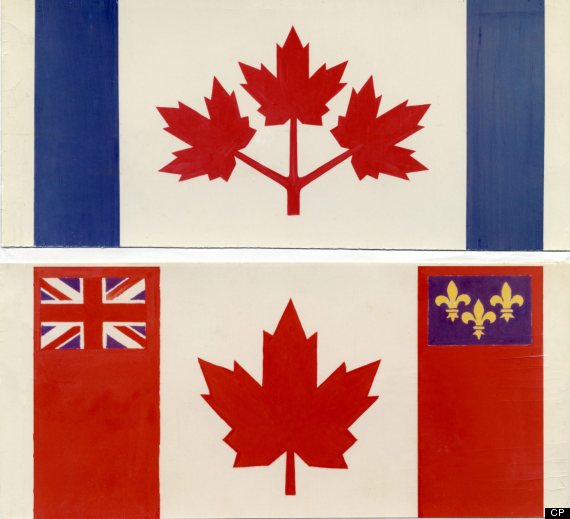
- 2136 contained maple leaves
- 408 contained the Union Jack
- 389 contained beavers
- 359 contained Fleurs-de-lys
One condition of the change, as promoted by the committee head, was that the design “be easy for schoolchildren to draw”, so that’s what eliminated the beaver & moose from consideration.
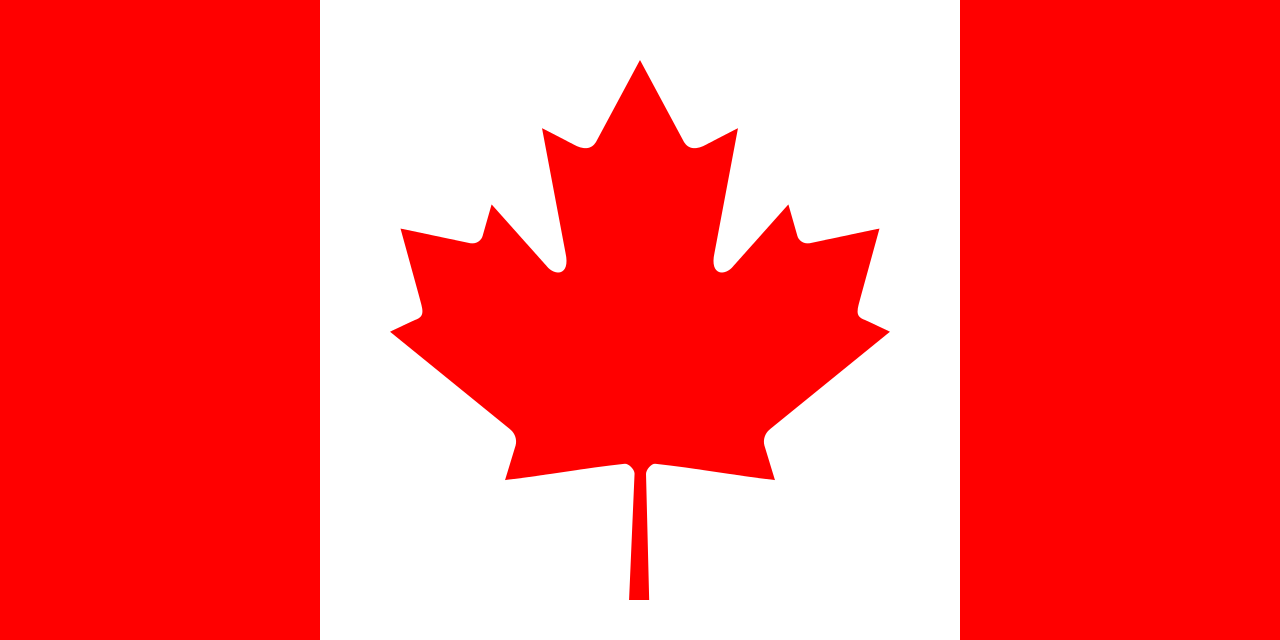
After a summer of taking submissions, and 6 weeks of debate, shortened by the forced closure of debate by the ruling Liberals (with help from the CCF & creditistes parties, the red and white version was approved on December 15, 1964, and became official February 15, 1965 – “Flag Day” (since 1996). Of all the versions submitted, this choice was made because:
- “red” for English heritage; “white” for French heritage. Red and white were declared official Canadian colours by King George V in 1921
- 2 bars for 2 coasts
- The Maple tree grows in every province, so it can be a national symbol
In comparison, the US Flag Day has its origins on June 14, 1777, when the Continental Congress decreed:
That the flag of the United States shall be of
thirteen stripes of alternate red and white,
with a union of thirteen stars of white in a blue field,
representing the new constellation.

It was first carried in battle on September 11, 1777 at The Battle of The Brandywine, the largest battle (by troop numbers) of the War of Independence. It was a one-day battle, where an overwhelming defeat of Washington’s forces led to the eventual British capture of Philadelphia on September 26, 1777.
Unofficial observances of a US Flag Day date from the 1880s. The generally recognized first comes from Wisconsin teacher BJ Cigrand, who started the tradition in his classroom in 1883. In 1893, the Society of Colonial Dames, led by Franklin descendant Elizabeth Gillespie, pushed for civic recognition of the date in Philadelphia. Flag Day became an official date of observance in 1949, when President Truman signed an Act of Congress declaring June 14th “National Flag Day”. Like Canada, it is a day of observance but not a “national holiday”.
If the US ever adds more states, I expect that flag changing discussion to dwarf the current, expected minimum 6 months about what to do with Scalia’s seat.

At any time during the course of a year, at least one country is having a national debate about changing its flag or other equally prominent national symbol. At present, New Zealand is preparing for a write-in ballot referendum lasting from March 3-26, 2016, on whether to keep their current flag, or switch to a new flag, with the four choices for replacement narrowed down to one in a previous referendum in November 2015.

If it passes, the version on the left will become the official flag by late 2016 or early 2017. The version on the right will stay official for the Rio 2016 Olympics. It is estimated that, via attrition, it will take 10 years to totally replace the current flag at all levels of the New Zealand government. All New Zealand are changing are their flag; other national symbols, coats-of-arms and membership in the Commonwealth will not change.
And there you have it. History can always be a fun discussion in class when it can be tied into something relevant. I’m somewhat glad I was able to use that abortion of an anthem attempt yesterday as something positive to begin a lesson on the importance of national symbols, and point out why nobody ever wants your unique interpretation of a national symbol or song.
In conclusion, I leave you with the salient words of Eddie Izzard on the concept of colonialism and flags.
Thanks for reading.
![Your “Let Us Never Speak Of It Again” Monday Evening Open Thread – [DOOR FLIES OPEN]](https://secure.gravatar.com/avatar/95e67409c5da293498c5f88e71a1f0de0dea50025a2cbf0aaf650dbecb7ab807?s=64&d=blank&r=x)









Leave a Reply
You must be logged in to post a comment.