![[DOOR FLIES OPEN]](https://doorfliesopen.com/wp-content/uploads/2015/08/DFO-MC-Patch.png)

The Oscars are almost upon us, with all their unpredictability. You don’t need an oracle to tell you what will happen. You don’t even need a film critic. You need someone who sees into the very souls of the Academy voters. You need a Straight White Man.
Guys, yesterday was hell. I couldn’t get all my work shit done, and I sure couldn’t get this done in the gaps where I wasn’t actively trying to get all my work shit done, and the result is my first post-Open Thread. It’s fitting that I had all this trouble on the day I decided to talk about writing, because writing is hard and no one should attempt to it, ever.
Before we get to the nominees, let’s pause to remember that Cary Joji Fukunaga’s screenplay for Beasts of No Nation was not nominated.
ADAPTED SCREENPLAY
The Big Short – The same basic argument for The Big Short has been made just about everywhere by now: Adam McKay took a book that ought to have been unfilmable, about a subject that no one understood and most people couldn’t be made to understand, and made it not just accessible, but one of the most downright entertaining films of the year, and maybe the most radicalizing. Most writers making a movie about the subprime mortgage crisis would have decided that trying to explain how mortgage-backed securities and CDOs work was a waste of time, dispensed with the specifics, and just told the audience that these were “bad bonds.” Adam McKay brought in celebrity cameos, Jenga towers, and metaphors about fish stew to explain why and how the bonds were bad, and the result was some of the best scenes in the entire movie.
Brooklyn – It’s hard to believe the same movie can be this sincere and this funny at the same time. The banter between Saoirse Ronan and her housemates makes for some of the film’s best and liveliest scenes; there’s an even better one, though that features her boyfriend Tony’s young brother gleefully disparaging the Irish to the animated disapproval of the rest of Tony’s family. What impressed me the most, though, was that the movie wasn’t afraid to bring the durability of Eilis’s relationship in America into genuine doubt, even before her return home. The seeds planted in that first half make her behavior in the second, which could easily have been frustrating and incomprehensible, seem human and relatable, if not exactly justifiable.
Carol – Almost all of Carol happens between the written lines of dialogue, or otherwise outside of them. It’s not that the characters don’t have important things to say, but they say the most with their eyes, with their body language, with their silences. The thing that earned this screenplay its nomination is an absolutely perfect story structure. The movie works almost like one very long joke, a two-hour setup for a single, sublime punchline. It’s the terror-horror dynamic applied, not to horror, nor to humor, but to romance, letting the tension build and build and at last relieving it in a final scene that’s excellent on its own strength and elevated to an all-time great movie moment by its context.
The Martian – I’m informed by an engineer friend that the book is even better than the movie. To that, I say: Thanks, Drew Goddard, for saving us all from the sort of adaptation that would have satisfied the engineers. A few of the best screenplays this year are notable for making potentially dry subject matter not just watchable, but positively riveting. The Martian shows enough of its work to have us impressed with the ingenuity of Mark Watney and his colleagues, but doesn’t get bogged down in showing all of its work.
Room – I had very little idea what to expect from Room when I started watching it. I had a vague sense of what it was about, really just enough to be perplexed when the movie resolved what appeared to be the primary plot conflict about halfway through. The first hour is tense, focused, and riveting, and the second half is like a completely different movie in the best way possible. There’s no longer a clear endpoint, and if that’s disorienting for the audience, it’s even more so for the two main characters. The ways in which they adjust—or don’t—are the source of the film’s biggest drama.
Will Win/Should Win: The Big Short.
Second Choice: Carol. I really, really don’t want to see this movie shut out, but I’m despairing to find anything I think it has a great shot at winning.
Upset Special: The Martian, which is currently getting 40:1 odds on the one site I checked. That’s ridiculous! Yeah, The Big Short‘s going to win. But if it somehow doesn’t, The Martian seems nicely positioned as a more conventional ensemble drama with a lot of snappy dialogue.
ORIGINAL SCREENPLAY
Bridge of Spies – Being a lawyer ruins cinematic courtroom drama. It makes you do things like watch the movie version of a Supreme Court oral argument and wonder why none of the justices have interrupted Tom Hanks yet. We’re worse than the engineers. If a lawyer had written this movie it would have been an hour of Tom Hanks objecting to leading questions, thirty minutes of Tom Hanks trying to convince the justices that a search incident to an INS administrative arrest without a separate search warrant violates the Fourth Amendment, and thirty minutes of Tom Hanks negotiating with Soviet and East German officials, and only that last thirty minutes might still have been okay to watch. As I alluded to in a previous post, bridges and walls serve as a recurring metaphor in this movie for communication and… well, stonewalling, the lesson being that the latter’s far more dangerous in the long run. It’s an apt—if not terribly new—observation about the Cold War, and it’s delivered with a deft touch.
Ex Machina – Can we talk, real quick, about what a great year Domhnall Gleeson is having? The man’s gotten to play opposite Best Supporting Actress nominee Alicia Vikander in Ex Machina, and opposite Best Lead Actress nominee Saoirse Ronan in Best Picture nominee Brooklyn. He’s in a second Best Picture nominee, The Revenant, that might be the favorite to win the top prize. And, oh, he’s also in Star Wars. The Ex Machina script makes him sort of an audience-surrogate, reacting to a sharply-written pair of charming-but-creepy characters in Oscar Isaac’s tech CEO Nathan and Vikander’s intelligent robot Ava. Ex Machina doesn’t offer any philosophical innovations when it comes to the subject of AI per se; it actually makes me think most of Her, one of my favorites from a couple of years ago. For all its futuristic trappings, Her was really a parable about all the ways we disregard our partners—romantic or otherwise—to make our relationships what we want them to be. It’s about the tension between getting what we need and want, and acknowledging the needs and wants of another real person. Ex Machina is what happens when you stretch that tension to its breaking point: Nathan wants to create an intelligence, but wants it to do what he tells it.
Inside Out – Surprisingly mature even by Pixar’s standards, with an evidently near-universal appeal, Inside Out was one of my absolute favorites this year. The movie felt to me like a whole new way to think about how we think, as though Pixar drew a detailed, three-dimensional map not just of one preteen girl’s mind, but also of my mind, and everyone else’s too. The way the protagonist—Amy Poehler’s Joy, literally the personification of happiness—misdiagnoses and worsens the problem she’s facing is one of the best metaphors I’ve seen onscreen for dealing with sadness by repressing it; if there’s a close competitor, it’s probably last year’s The Babadook, of all things.
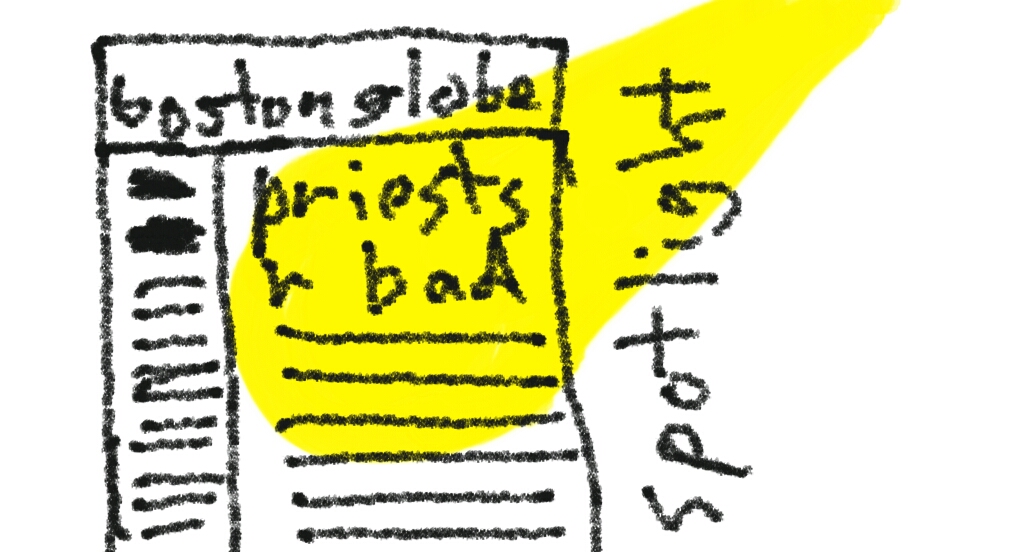
Spotlight – As a former copy desk chief for a college daily, I know better than to think that real newsrooms are exciting. Writing news is a slow, boring process, and reporting is worse, which is why I always preferred to just edit other people’s stuff. It’s also why I respect good journalism so much. Not because it’s “courageous” or whatever, but because it’s important and also really fucking hard to do right. Spotlight‘s script, thankfully, distills the often-tedious process down to a fast-moving newsroom procedural that highlights the tenacity of its real-life heroes and the exasperating inhumanity of the plot they exposed.
Straight Outta Compton – Because I’ve been performing this Straight White Man role for a very long time, I didn’t really know anything about NWA before seeing Straight Outta Compton, and so I’ve got no insight to offer on the historical accuracy of the film. When I watched Compton, it was like it was performing a juggling act with its characters, except all the balls are self-propelled and have very different ideas where they ought to be going. Every person in this film seems to be developing in a different direction, at a different rate, but they bounce off each other in believable ways.
Will Win/Should Win: Spotlight. Like turn-of-the-century German soccer, Spotlight is nearly perfect and you’ll have a hard time explaining to your friends why it’s entertaining.
Upset Special: Inside Out.






Leave a Reply
You must be logged in to post a comment.