![[DOOR FLIES OPEN]](https://doorfliesopen.com/wp-content/uploads/2015/08/DFO-MC-Patch.png)

Part 2 – Who Are the Main Parties:
Well, well, well – look who’s back two weeks in a row?

No.

No

Now you’re just hurting my feelings.
Look dummies, it’s me – Beerguyrob.

Well, despite what you think, I’m going ahead with the second part of my primer. The debates start tonight, so if you want to know what’s what about the lead stories on Canadian news, or the 18th story on CNN at 3:00AM, here’s all you need to know about the groups involved.
(All information is from my school notes, except where indicated.)
Part 2: The Political Parties
The USA is one of the few countries in the world, outside of communist dictatorships, that has a rigid two-party system in place. Given their entrenched status, it forces potential candidates to endure so-called “purity tests” in order to gain nomination for office. It’s what also has resulted in a lack of expansion of political theory in the US, much to its detriment.
In Canada, we have five main political parties, plus a sixth amalgam of libertarians & right-wing crazies. It’s what you get when you inherit a political system that after 400 years of experimentation has resulted in the Monster Raving Loony Party. They can be divided into three main groupings – traditional governing; viable small-party alternatives; and no-chancers.
Traditional Governing Parties:
- The Liberal Party of Canada

One of two original political parties in Canada
- The party was formed at Confederation (1867)
- a combination of Ontario and Quebec regional parties
- Canada West True Grits
- Canada East rouges
- a combination of Ontario and Quebec regional parties
- It traditionally occupies the “middle ground” in Canadian politics
- allows it to ‘steal’ ideas from both the left and right wings
- from the left it took & popularized ideas like medicare & pensions.
- The CCF/NDP originated them, but the Liberals brought in less-extreme versions, making them the party of those policies.
- from the right it moderated tax rates & broadened foreign investment.
- The Conservatives wanted lower taxes & increased foreign investment, but the Liberals kept them restrictive enough to pay for their stolen left-wing programs.
- this is why they have been the most elected governing party in Canada
- They have been the government for 92 of Canada’s 154 years, and 84 of the 121 years since 1900.
- from the left it took & popularized ideas like medicare & pensions.
- allows it to ‘steal’ ideas from both the left and right wings
- It has a policy of alternating between English and French leaders, and normally chooses people from Ontario or Quebec.
- to maintain a strong central Canadian voter base
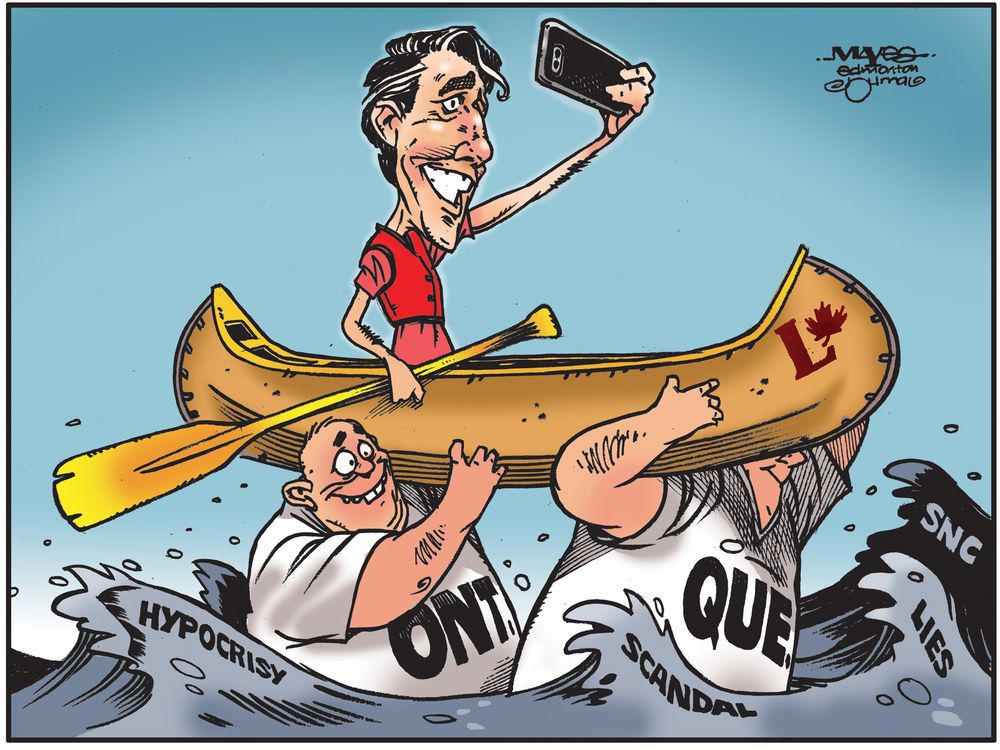
- suffers in popularity due to the periodic rises in regional support of the Conservatives (Ontario) and the Bloc (Quebec)
- their leaders make Liberal ‘middle ground’ seem like weakness
- the more extreme those leaders and/or parties become turns people back to the Liberals
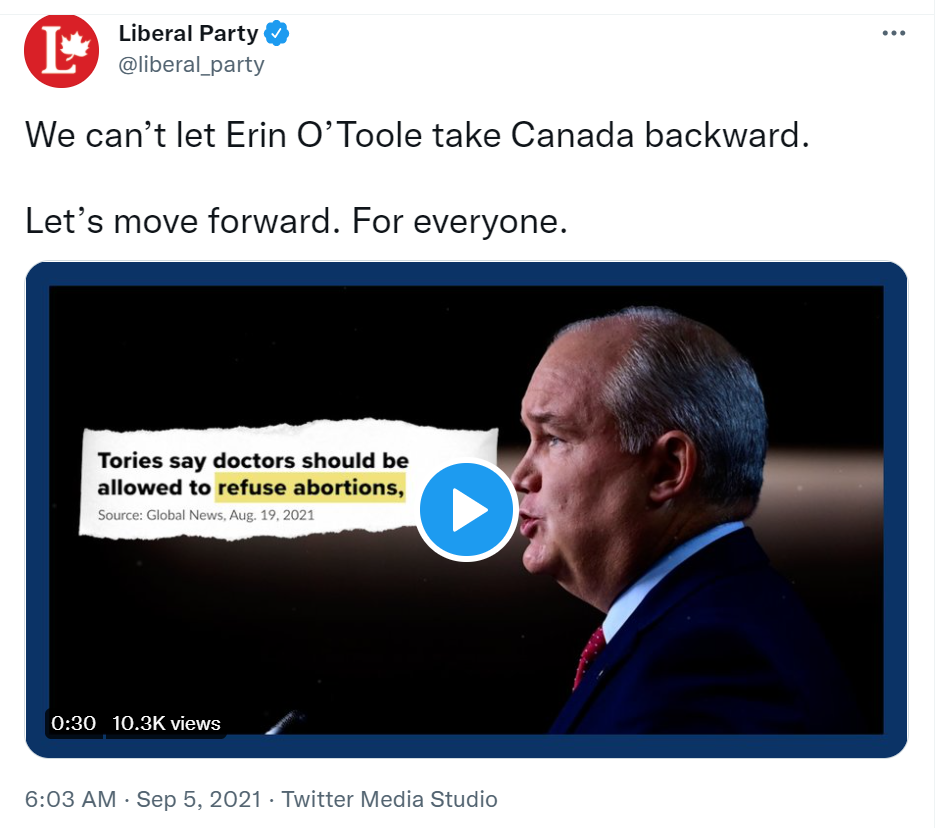
- which is why you’ll eventually hear Liberal candidates start asking Tories about abortion.
- oh look – right on schedule, three days before the official debates:
- which is why you’ll eventually hear Liberal candidates start asking Tories about abortion.
- They have suffered from bias in the Prairie provinces over perceived preferential treatment of Quebec at the expense of the West
- in awarding government contracts and farming & energy policies
- ask an old-timer about the “Crow Rate“
- because Pierre Trudeau is blamed for
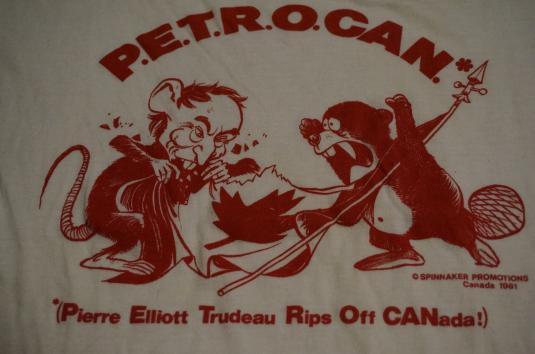
- the National Energy Program, which in the 1970s forced oil-producing provinces to sell oil below-market value to eastern Canada, to alleviate the energy crisis
- the Official Languages Act, which “forced” French into non-traditional regions of the country
- official multiculturalism, which encouraged immigrants to keep contact with their heritage, so – “_______ – Canadians”, as opposed to the US “melting pot”, where people are expected to become unhyphenated “Americans”
- because on its own Quebec is, in terms of representation & population, as important as the three Prairie provinces
- Quebec has 78 seats in the House of Commons; the three Prairie provinces have 62.
- BC has 42 seats, but is treated differently than the Prairies in terms of importance.
- in awarding government contracts and farming & energy policies
- Current leader: Justin Trudeau
——————————————–
B. The Conservative Party 
The second of Canada’s two founding political parties.
- As with the Liberals, they were a combination of Ontario and Quebec regional parties
- Canada West Tories
- Canada East bleus
- The Conservative Party, as a political party, has existed in Canada since 1867, and formed the first “Canadian” government after Confederation in 1867.
- led by John A. Macdonald
- They have had different names through their history.
- Liberal-Conservative Party – 1867-1873
- Conservative Party – 1873-1942
- Progressive Conservative Party – 1942-2003
- Conservative Party – 2003-present
- The modern iteration of the party was the result of a 2003 merger between the Progressive Conservative party (economic conservative) and the Canadian Alliance party (social conservative)
- based in an attempt to “unite the right”
- the Alliance was strong in the West – led by Stephen Harper
- the PC’s were strong in the Atlantic provinces – led by Peter Mackay
- the two parties consistently ‘split’ the rightist vote in Ontario and Quebec
- allowing the Liberals to win seats even though, technically, they received less votes than the right wing parties combined.
- ultimately, the move was successful
- they won 99 seats in the 2004 election, becoming the Official Opposition
- they won 124 seats in the 2006 election, and formed a minority government
- Stephen Harper became Prime Minister
- the Liberals entered a seven-year period of leadership unrest, ending in 2013 when Justin Trudeau ascended the throne.
- based in an attempt to “unite the right”
- They have traditionally struggled to gain support in Quebec and urban Ontario.
- In Quebec, it has been because of grassroots anti-French platforms & members.
- Most western Conservatives distrust Quebec politicians, seeing them as more pro-Quebec than pro-Canada.
- In Ontario (and Quebec), the social conservatism of rural members alienates socially liberal urban voters.
- Policies restricting immigration & language rights hurts candidates in multicultural ridings.
- As recently as August 19th, their leader had to make an official statement declaring his support for Canada’s abortion laws.
- As opposed to previous leader Andrew Scheer, whose “socially conservative views on abortion and LGBTQ rights contributed to the Conservative loss of the 2019 election.”
- In Quebec, it has been because of grassroots anti-French platforms & members.
- Naturally, the times they have picked a non-Western Canadian as a Conservative leader, he immediately came under suspicion as being too socially & economically liberal.
- Because attempts to use governing to benefit the new regions supporting them is viewed as taking away benefits that would have gone to traditional (read: “loyal”) regional supporters.
- their current leader is the first non-Westerner since Brian Mulroney resigned in 1993.
- not counting the years of the split between the PCs and the Reform/Alliance.
- Traditional Canadian voting patterns dictate the Conservatives, in whatever form, win an initial election more because the voters are tired of the Liberals than deliberately vote for the Conservative party.
- Many times, they have misread the result as a vote “for” them, leading to a one-term government before people turned back to the Liberals.
- Their desire to swiftly implement their agenda gives the impression of vindictive undoing of previous policies, no matter their popularity
- If a Conservative government wins a second majority election, it is then because people chose to vote for them.
- Only two Conservative leaders have ever won consecutive majority governments: (Robert Borden doesn’t count because he was a “Unionist” during WWI)
- John A Macdonald – 1867-74; 1878-91
- Brian Mulroney – 1984-1993
- Only two Conservative leaders have ever won consecutive majority governments: (Robert Borden doesn’t count because he was a “Unionist” during WWI)
- Many times, they have misread the result as a vote “for” them, leading to a one-term government before people turned back to the Liberals.
- current leader: Erin O’Toole
Viable Small/Third-Party Alternatives:
C. The New Democratic Party (NDP) 
An actual “socialist” party.
- originated in the 1930s as the Co-operative Commonwealth Federation (CCF), led by J. S. Woodsworth.
- formed as a socialist response to the Great Depression (1930-38)
- based in “Prairie Populism” and socialism
- using both the power of the state and community to help solve the Depression
- the CCF had limited success
- farmers are not a large voting group
- had regional success in Saskatchewan and Manitoba
- it suffered a severe loss of support during the 1950s-era “Red Scare”
- The 1933 “Regina Manifesto” and its talk of replacing capitalism with “democratic socialism” came across as communist
- in 1961, the CCF merged with the Canadian Labour Congress (CLC) to form the NDP.
- The CCF adopted organized labour into the movement to try and broaden their appeal.
- In an attempt to make political inroads in Ontario and Quebec, by moderating its platform and hopefully forming a broader power base
- The CCF adopted organized labour into the movement to try and broaden their appeal.
- constantly hurt by the Liberals stealing their ideas
- policies like medicare, pensions and UI/EI were conceived by the CCF/NDP.
- party support is inversely reliant on the economy
- good economy = low support
- as NDP high tax policies alienate the newly wealthy
- weak economy = high support
- people want the government to give them ‘stuff’
- that others’ taxes have paid for
- people want the government to give them ‘stuff’
- good economy = low support
- had never won more than 40 seats in a federal election prior to 2011
- their traditional role was as a ‘spoiler’ or conscience of Parliament
- Spoiler, in that they can help bring down (or build up) a minority government
- Conscience, in that they support most human rights causes, voicing them in Parliament & bringing them to the national consciousness
- topics like abortion, right-to-die, and social justice legislation
- their traditional role was as a ‘spoiler’ or conscience of Parliament
- They won 103 seats in the May 2011 election, becoming the Official Opposition for the first time in their history (which also drove the Liberals to pick Justin Trudeau)
- but the death of then-leader Jack Layton in August 2011 precipitated a popular decline as infighting began over the direction of the party
- the leadership race to replace Layton exposed cleavages between middle-grounders and die-hard socialists that Layton’s replacement Tom Mulcair couldn’t bridge
- they lost most of their support from 2011 and fell back to third-party status in the 2015 election, bottoming out at 24 seats after the 2019 election.
- they failed to realize that Jack Layton was the reason for their 2011 support, not their policies.
- He was a ‘Tony Blair’ socialist – socialist enough to keep the traditional supporters happy; mainstream enough not to scare off business with talk of extreme taxes & unionization.
- It won them broader support than they ever could have predicted.
- Their swift drop after his death showed where the influence truly lay.
- It won them broader support than they ever could have predicted.
- He was a ‘Tony Blair’ socialist – socialist enough to keep the traditional supporters happy; mainstream enough not to scare off business with talk of extreme taxes & unionization.
- the leadership race to replace Layton exposed cleavages between middle-grounders and die-hard socialists that Layton’s replacement Tom Mulcair couldn’t bridge
- but the death of then-leader Jack Layton in August 2011 precipitated a popular decline as infighting began over the direction of the party
- Despite their claim to be the party of organized labour, their inability to win election in the sixty years since the merger has caused union support to bleed away.
- mostly to the Liberals, as they have been the government or the Official Opposition.
- resulting in policies of “strategic voting” to get a favourable government for their members to benefit from.
- as big unions agree to support, or not oppose, a party they believe likely to form a government.
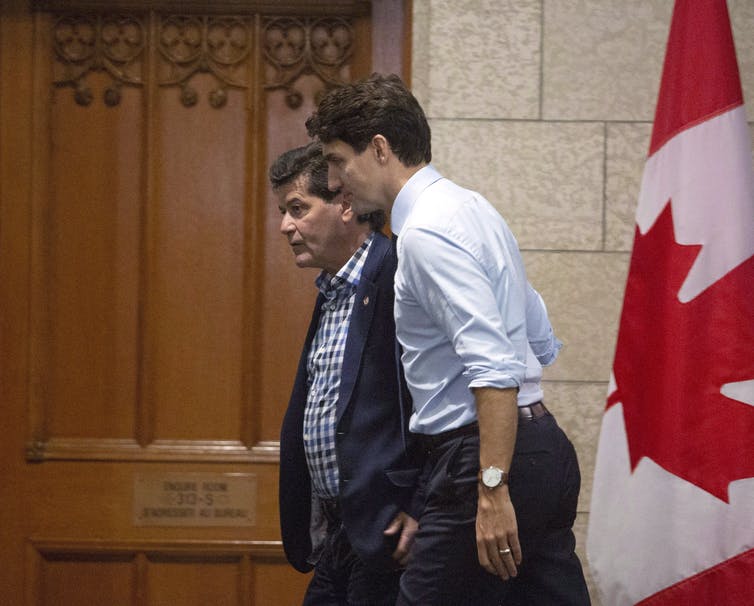
- Current federal leader: Jagmeet Singh
——————————————–

D. Bloc Quebecois
Founded in 1990; runs only in Quebec.
- By a former Conservative MP named Lucien Bouchard.
- who left the Tories because he felt PM Mulroney & Canada ‘betrayed’ Quebec when it came to protecting Quebec’s “distinct society” in the Canadian Constitution.
- He felt Quebec’s separation from Canada was the only way to protect from absorption into the larger Anglo North American society.
- Because Quebec – stealing a line from former separatist Rene Levesque – was a “French lifeboat in an English sea”.
- He felt Quebec’s separation from Canada was the only way to protect from absorption into the larger Anglo North American society.
- who left the Tories because he felt PM Mulroney & Canada ‘betrayed’ Quebec when it came to protecting Quebec’s “distinct society” in the Canadian Constitution.
- The party sees their role as protecting Quebec’s interests in Ottawa.
- to prepare the province’s way for eventual separation.
- to protect the province from having its identity watered down by government policy.
- They do not (claim to) represent all French Canadians.
- Just residents of Quebec ⇒ “Quebecois”
- Prior to 2011, always drew a consistent 35-40% in Quebec
- low ‘national’ numbers reflects a survey of the country – they poll between 8-10% “nationally”.
- The ‘true’ BQ numbers requires multiplying their poll numbers by 4.
- they were the Official Opposition after the 1993 election, coming second to the Liberals.
- Their 54 seats were the result of Quebec nationalists leaving the Conservative Party en masse, winning many of Quebec’s rural & non-Montreal seats.
- They also took advantage of the PC – Reform split to lure disaffected conservatives into their party, or to at least vote for them.
- low ‘national’ numbers reflects a survey of the country – they poll between 8-10% “nationally”.
- They were reduced to two seats after the 2011 election.
- as the movement had weakened, members bled off to the Liberal or Conservative parties.
- They rebounded to 32 seats in the 2019 election
- they regained support as nationalist voters chose the Bloc to be their opposition voice in Ottawa, not the Conservatives or NDP.
- Current leader: Yves-François Blanchet
No-chancers:
E. The Green Party 
There are different origin stories for the Green Party worldwide:
- Some say New Zealand, where it grew out of the Values Party (founded 1972)
- Some say Britain, where it grew out of the PEOPLE Party (founded 1972)
- Some say Belgium, which was the first country to elect Green-issues MPs to their federal parliament
- Some say Germany, where it grew out of the 1970s anti-nuclear movement
In any event, the Canadian Green Party was officially founded at a national convention at Carleton University (Ottawa) in 1983.
- Their early electoral focus was in Quebec, due to the number of initial party members from the province.
- They won 2.4% of the vote provincially in the 1988 election.
- They lost most of those Quebec supporters to the founding of the Bloc Quebecois in 1991.
- They saw separatism & environmentalism on the same side.
- Also not helping – the leader of the Quebec wing made a number of anti-Semitic comments which cost them broad popular support
- In the 1990s, the party chose to focus on British Columbia
- Aided by a rise in general environmentalism due to old-growth logging protests
- 1997 – elected Jean Russow of BC as their leader
- She led the party until her arrest at the 2001 Free Trade of the Americas summit in Quebec.
- By 2004, under leader Jim Harris of Ontario, they ran their first truly national campaign
- Running candidates in every Canadian riding – only the fourth party to ever do so.
- They won 4.3% of the national vote, and began to qualify for federal election funding, allowing them to expand their efforts.
- But his exposure brought accusations of mismanagement of resources
- His attempts to broaden the party’s appeal moved them politically towards the centre
- Alienating long-time members, leading to significant resignations.
- He stepped down after the 2006 election.
- His attempts to broaden the party’s appeal moved them politically towards the centre
- Running candidates in every Canadian riding – only the fourth party to ever do so.
- He was replaced by Elizabeth May, of Victoria, BC
- She led the party from 2006 to 2019
- In 2011, she made history by becoming the first Green elected to the House of Commons
- She resigned as leader after the 2019 election
- They had increased their number of MPs to 3
- Current leader: Annamie Paul
——————————————–
F. The People’s Party of Canada 
They were formed by Maxime Bernier in September 2018, shortly after his resignation from the Conservative Party.
- After his loss to Andrew Scheer in the 2018 Conservative Party leadership convention.
- This was kind of like what Lucien Bouchard did when he founded the Bloc.
- He claimed that the Conservatives had become “too intellectually and morally corrupt to be reformed.”
- Further, that the “Conservative Party has abandoned conservatives. It does not represent them anymore. And it has nothing of substance to offer Canadians looking for a political alternative.”

- The party has a communist-sounding name; not a communist party.
- They have staked out space on the political spectrum as the libertarian-leaning option in the upcoming election.
- Their website says they want to bring together “common sense, populism, classical conservatism, and libertarianism.”
- They have staked out space on the political spectrum as the libertarian-leaning option in the upcoming election.
- They haven’t had a sitting MP since 2019, when Maxime Bernier lost his seat in that year’s election.
- They polled 1.6% of the national vote in total, or just under 300,000 votes.
When he announced his resignation from the Conservatives in 2018, Bernier said that if his followers “want conservative principles to win the battle of ideas, we have to defend them openly, with passion and conviction.”
- In that vein, they have become the main anti-vaxxer party in Canada.
- Bernier has spent the majority of the pandemic challenging COVID restrictions across the country.
- To the point that he is unable to campaign in the Atlantic provinces due to their restrictions & risk of arrest because
- he refuses to get vaccinated
- he refuses to follow the provincial orders in place mandating campaign rally sizes & COVID protections.
- To the point that he is unable to campaign in the Atlantic provinces due to their restrictions & risk of arrest because
- Some of his candidates are openly promoting opposition to the pandemic mandates & vaccines.
- For example, their candidate for the Ontario riding of Barrie-Innisfil stated in an interview,
- “There should not be a mandate for an experimental drug that has been produced so rapidly. We know it’s killed people. We know the media has been silenced on this and quite a lot of things as well. It should be up to the person themselves if they want to take the jab or not. It’s not even a vaccine; it’s a lie that our government is telling us.”
- Another candidate, in the New Brunswick riding of Saint John-Rothesay, recently screamed at the provincial Education Minister at a public event about vaccinations & masks in schools,
- “They are not the states children. That is absolutely against everything …You are a piece of s***. You are absolutely disgracing parental rights. You are a human rights violator.”
- For example, their candidate for the Ontario riding of Barrie-Innisfil stated in an interview,
- Their supporters were the ones behind the recent protest-caused cancellation of a Justin Trudeau rally.
- Bernier has spent the majority of the pandemic challenging COVID restrictions across the country.
-
- Because of shit like this, and his party’s low ranking in national polls, they have been excluded from the official National Leaders’ Debates.
- Nobody hears what the party itself has to say anymore, because all people picture are lunatics carrying their banners blocking buses & throwing shit at other leaders’ rallies.
- Which they are still leaning into, most recently with their supporters throwing gravel at Justin Trudeau outside a brewery during a campaign visit.
- But the recent fall of Green support during the campaign may lead to their late inclusion into the English debates.
- Nobody hears what the party itself has to say anymore, because all people picture are lunatics carrying their banners blocking buses & throwing shit at other leaders’ rallies.
- Because of shit like this, and his party’s low ranking in national polls, they have been excluded from the official National Leaders’ Debates.
- Current leader: Maxime Bernier
Polling & Debates:
I mentioned above how national polling plays a role in determining who qualifies for the debates. Officially, qualification for the debate comes down to specific factors, as laid out by the non-partisan Leaders’ Debates Commission., which is mandated to act in this role under Order In Council 2020-871.
The specific criteria, as laid out by the Order In Council, says qualification for inclusion is based on the fact that:
- They must be represented in the House of Commons by at least one MP elected under the party banner on the date the election is called;
- They must have won at least four per cent of the national vote in the 2019 election; and
- They must show they receive at least four per cent national support, five days after the election is called as measured by public polling, using an average of leading national public opinion polling organizations
So, as an example, here is a NANOS Research poll from August 20th, one of the many used to help determine eligibility:
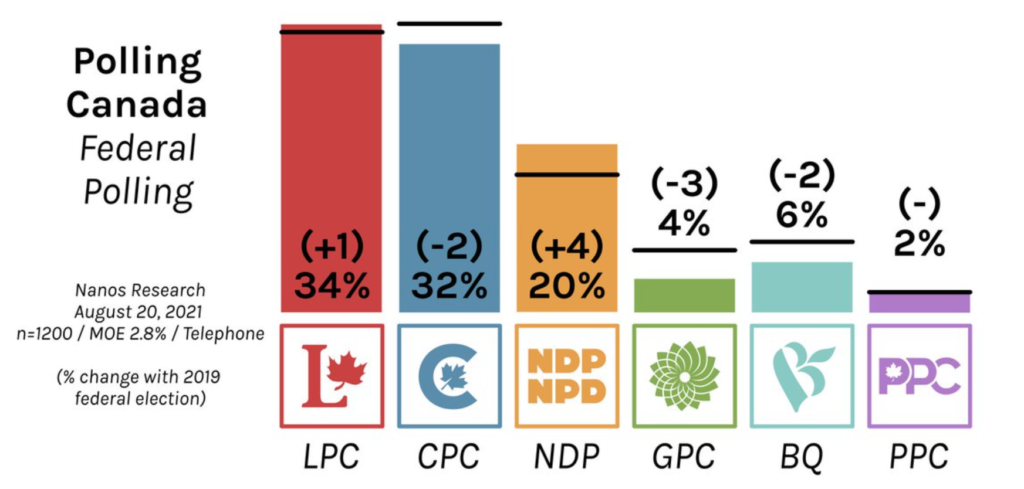
As you can see, five of the six parties qualify for inclusion based on these results. There may be a chance the debate commissioner, former Governor General David Johnson, allows him to participate (in interests of “fairness”) like he did in 2019. Recent polling data seems to indicate he might,
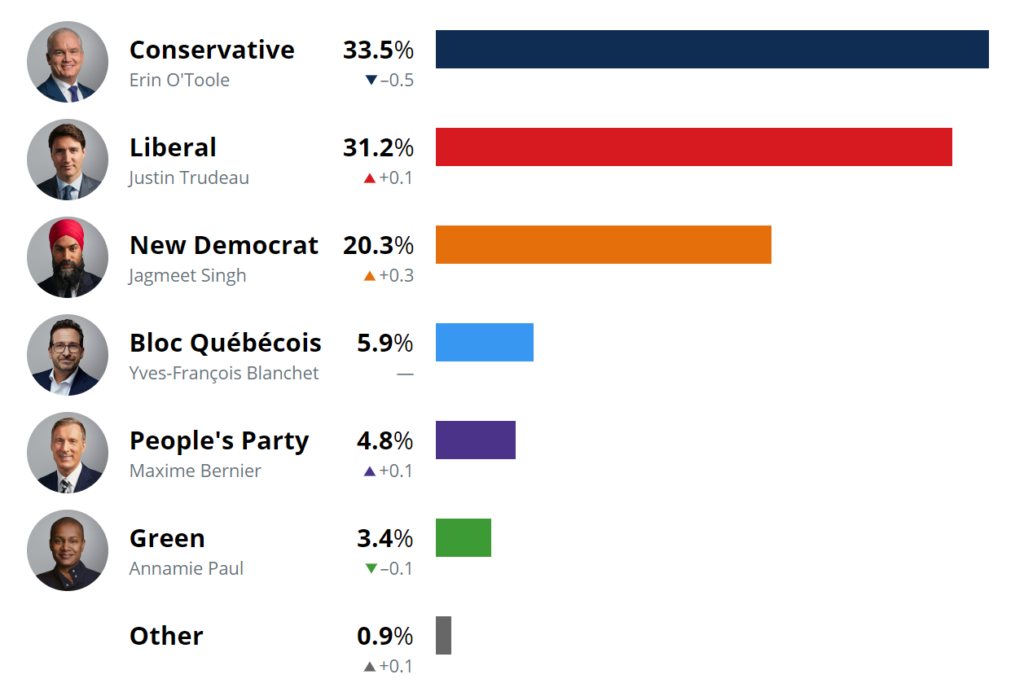
but it could also be too late, given that the French debate starts at 8:00pm tonight. Also, he’d have to get the support of the existing participants, which seems unlikely given the dirt throwing and Bernier’s general unpleasantness.
The French-language debate is scheduled for September 8th, from 8 to 10 p.m. EDT and the official English leaders’ debate is scheduled for September 9th from 9 p.m. to 11 p.m. EDT, both at the Canadian Museum of History. The debate topics each night will be the same:
- Affordability
- Climate
- COVID recovery
- Leadership and accountability
- Reconciliation
——————————————–
The other thing the election-call poll is useful for is discussing the Bloc Quebecois’ polling strength.
Because this is a “national poll”, the Bloc totals just 6% support nationally. However, since they run only in Quebec, these numbers are very skewed against them. (The closest US example would be how Trump voters refused to answer pollsters questions, so he lagged behind both Hillary & Joe in polls leading up to the elections.) If you look at Quebec’s provincial population – 8.45 million as of 2019 – versus Canada’s overall population – 37.6 million as of 2019 – that gives Quebec 22.5% of the population. So, if we extrapolate that percentage into the national polling data, it gives the Bloc a provincial standing of roughly 27%.
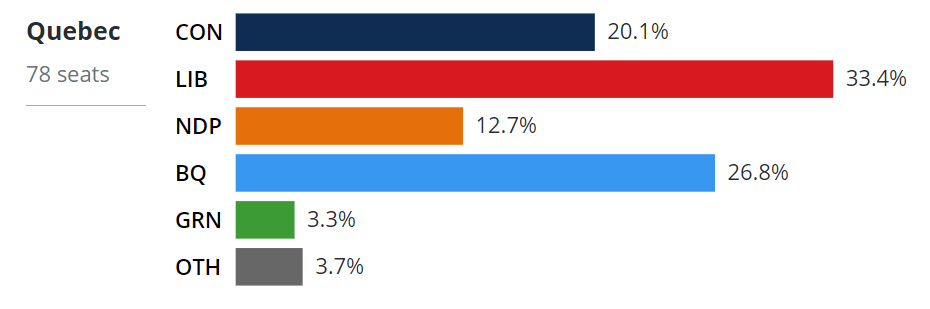
Factor in that the Conservatives & NDP aren’t that strong outside of Montreal, and the Bloc likely have roughly a standing of 30-35% within the province. This roughly equates to them likely winning 30-40 seats, hurting the Liberals chances of winning a majority.
The Bloc’s polling data, in fact, is a prime example of the national polling flaws that exist in Canada. The Liberals are the only truly “national” party when it comes to accuracy of polling data, since they have a standard base in every province. To refer back to the table above, the 34% for the Liberals is the most accurate reading on the board. When it comes to the Conservatives, their data skews strongest in the West, where they are likely to get their strongest numbers due to decades of rampant anti-Liberalism. This means that their numbers will be artificially high nationally because they received an overwhelming vote of support among the old people in Calgary who answered the phone. If you see the black line above their blue bar, that was their percentage of the vote in 2019 – note how it’s higher than the Liberals. On paper, they “won” the 2019 election; but like Hillary’s popular vote, that didn’t mean shit because of how they won. They won more votes but fewer seats because where they won, they won by an average of 4,000 votes; the Liberals won by an average of 2,000.
Let’s compare Ontario versus Alberta. In Ontario, the Liberals hold a slight provincial lead.
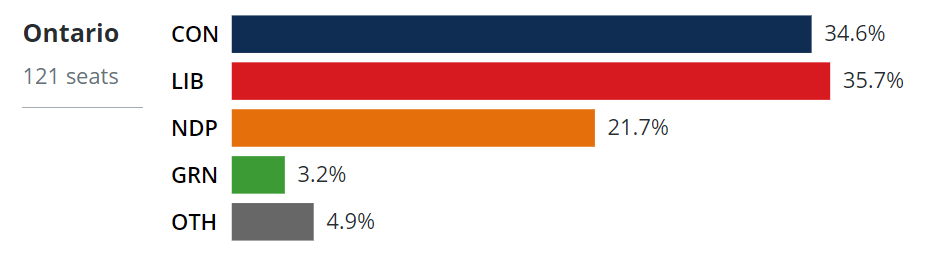
Given the number of seats that are available, it is the biggest political prize in the country, and is why they are concentrating a large amount of their campaign there. Leading the Ontario poll is more important than leading the national poll, because of how rich the reward is. If they can hold onto what they have here, this will ensure they have the best shot at forming a government.
Meanwhile, in Alberta,
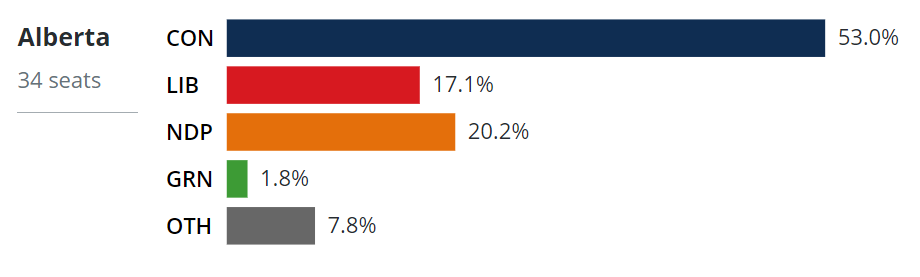
the Conservatives are all set to win most if not all of the seats in Wild Rose country. It’s not surprising, given that Alberta is the home of Canada’s social conservative movement, and most voters over 60 still boycott Petro-Canada stations over the National Energy Program from the 1970s.

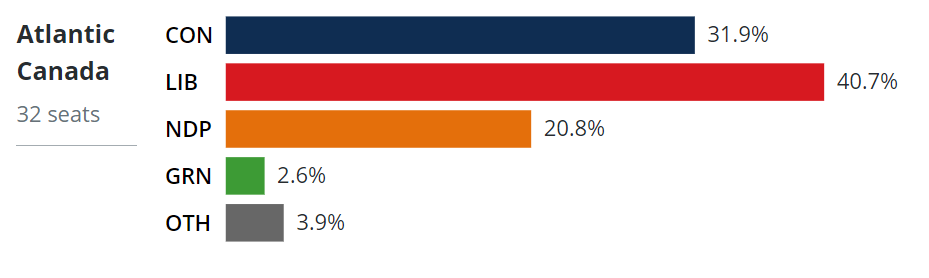
All this vitriol would actually mean something, if they weren’t all set to lose every seat in Atlantic Canada.
And that’s a Canadian election in a nutshell. In a 3-5 party race per seat, the advantage lies with the party that has the most stable voting bloc. This is the relative advantage/disadvantage of the “first past the post” system I discussed in Part 1 of the series.
That wraps up an examination of the parties & their platforms. Next week, it’s a more specific look at the leaders, and who among them will become the next Prime Minister of Canada. (Hint – there’s only two choices.)







Leave a Reply
You must be logged in to post a comment.