![[DOOR FLIES OPEN]](https://doorfliesopen.com/wp-content/uploads/2015/08/DFO-MC-Patch.png)


Good morning. Thanks for stopping by. I’m just rushing out to play golf, but I have a few seconds to take a look at what’s going on here. And… oh. How did you cut yourself using a plastic butter knife? Do I even want to know? I may be your doctor, but as your friend, too, I’m embarrassed for you. I’ll see if I can treat you further while I’m out on the golf course, but for now, go home, find a comfortable place to sit, elevate the wound and expose it to the air, and kill some time by reading this pamphlet. Hopefully it’ll make more sense in due time.

POWDER OF SYMPATHY: NOT COCAINE, BUT NOT BAD!
What are the positives of this treatment?
Imagine a substance that, if applied to the blade of a weapon that had wounded a person, could instead heal them without ever touching them… The idea sounds ridiculous and absurd, but in the 17th century, a gallivanting scoundrel of an Englishman by the name of Sir Kenelm Digby began to push the idea hard across Europe. According to our resident rapscallion, who was renowned as a man of science in the 1640s and later became a member of the prestigious Royal Society, sympathetic powder works by being applied to a dressing that has previously covered a wound – and not from touching the wound itself. Thanks to “sympathetic magic”, the wound would then heal completely independently – without any human contact necessary.
It’s not 100% confirmed what ingredients are involved to make the powder, either, but it’s believed that green vitriol (iron sulphate) was the main component. Other less common “weapons salves”, which were used for essentially the same purpose, were made of more exotic and rare materials, including “skull moss”, which grows on human skulls exposed to the elements as the bodies decompose. Weapons salves were explicitly applied to weapons that had injured a specific person, while powder of sympathy had much wider-ranging use cases. Other potential ingredients could have also included powdered toad carcasses, according to the minutes of one Royal Society meeting from 1661.

Another Englishman and Royal Society member, Sir Gilbert Talbot, seems to have taken sympathetic magic to impressive heights; after being injured in the Siege of Tiverton Castle during the English Civil War in 1645, Talbot is alleged to have cured himself of his wounds and used powder of sympathy to heal wooden splinters without touching his body to remove said splinters… though apparently his body was bruised for weeks afterwards following the procedures.
If powder of sympathy is effective… The ramifications are incredibly powerful. Telemedicine would become even more lucrative, and ER wait times would drop dramatically.
What are the negatives of this treatment?
Asides the fact that it doesn’t work and is completely absurd, and any supposed benefits are likely merely a placebo or psychosomatic? Well, prolonged suffering of patients is typically frowned upon. Also, salve ingredients like skull moss are incredibly rare and expensive; most insurance providers are almost certain not to cover the cost to patients either. Otherwise, there’s no downside whatsoever!
What are some real-life examples of this treatment?
In the early 17th century, the Roman Catholic Church in Belgium was furious at physician Johann Baptist Van Helmont for being one of the largest advocates of powder of sympathy. They accused him of promoting superstition – a serious charge in this era – and persecuted him heavily, though Van Helmont was a deeply religious man; he was fortune to avoid outright excommunication. Van Helmont, despite this obsession with sympathetic magic, did give Western civilizations some extremely notable scientific discoveries in chemistry; he is considered the father of pneumatic chemistry, and he gave us the English word “gas” in reference to the changing states of matter (which is derived from the Greek “chaos”; the Flemish word for “gas” is much closer in pronunciation to this Greek origin word). Van Helmont was also greatly enamoured of the famous Swiss physician, alchemist, occultist and philosopher Paracelsus, who posited that sympathetic treatments were medically reasonable, as the entire universe was in connection with itself, and that these treatments, if done properly, could clearly establish a direct between all the forces at play in both the wound and the treatment. These beliefs reflect much older Greek and Roman traditions; in fact, even older still, some evidence of ritual performance for good hunting in what is now Namibia and South Africa demonstrate this link between human belief in like-minded materials being able to foster specific connections and outcomes. Some cave paintings and sculptures from thousands of years ago appear to demonstrate not a successful hunt, but rather, a premonition of what they hope the outcome to be; broken stones with cuttings in places that resemble a wound to an animal’s hindquarters could be, in some factors, akin to how voodoo dolls are believed by some to be able to inflict pain and suffering on the specific person who the doll is modelled after.

How can we improve this treatment for the future?
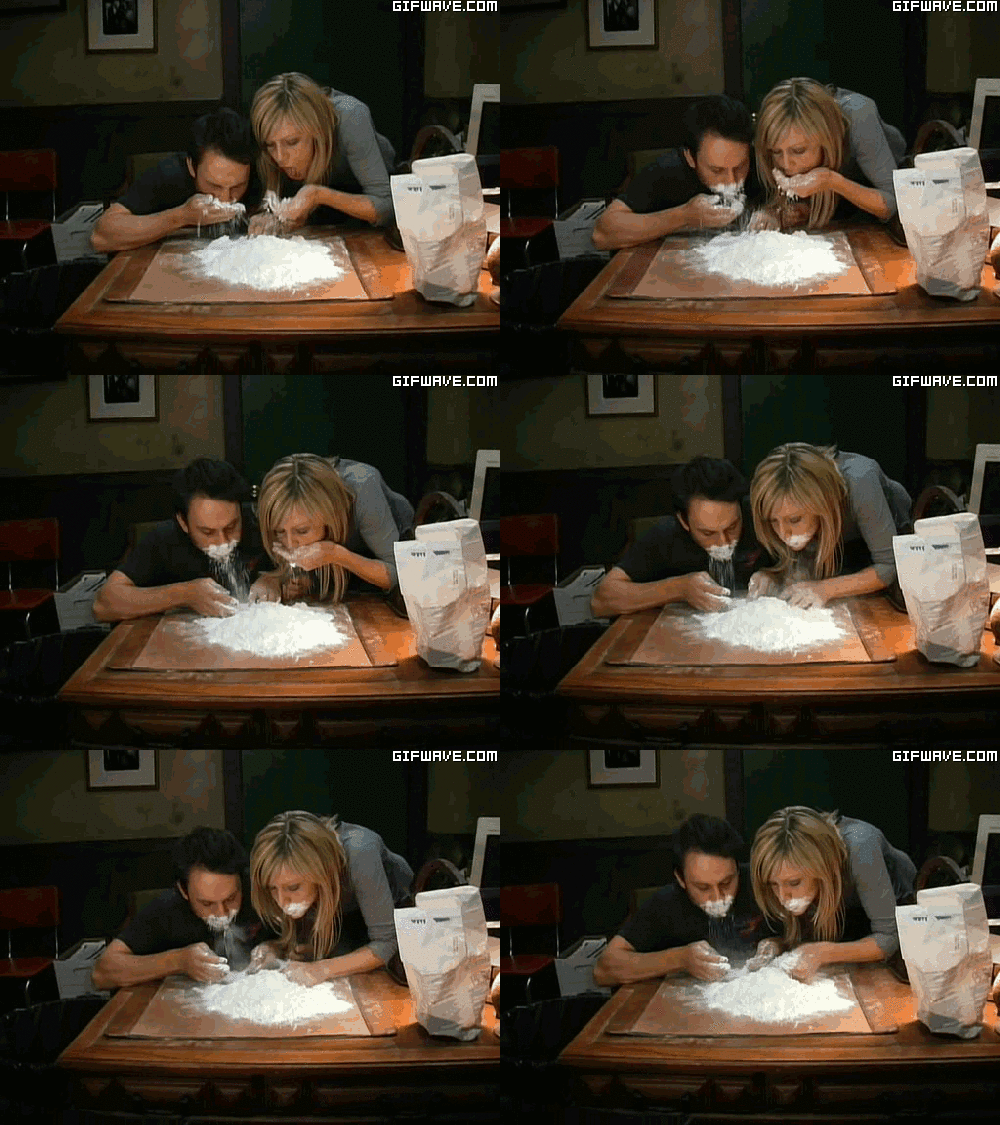
Listen, if you want a powder that will heal all wounds with limited human contact, I have just the ticket for you! Please note that it requires a rolled-up dollar bill and a credit card in order to avoid being touched when you are administering it. Also, it won’t explicitly heal any outright bleeding wounds, but it’ll definitely make you forget about them for a while. Also, I can’t prescribe it myself, but stand in line long enough to cross the border from San Diego into Tijuana, and I can get you the phone numbers of at least twenty people who can… Oh, and bring cash.
***
Information for this article taken from here, here, here, here, here, here, here, here, and here.








Leave a Reply
You must be logged in to post a comment.