![[DOOR FLIES OPEN]](https://doorfliesopen.com/wp-content/uploads/2015/08/DFO-MC-Patch.png)

We just recently finished the semifinals and are eagerly awaiting the final and I don’t think everyone is happy.
This is where I usually come in. Let’s just say the Balls-Signal went out.

As usual, I will come in and either fix things or make them worse with everyone complaining about me sticking my balls where they don’t belong.
Story of my life.
I think we can all agree that the way the college football national champion has been determined has been flawed since the championship was instituted. I alluded to this in my Miss Universe post. Any determination using subjective criteria is flawed.
The funny thing is that it doesn’t have to be this way. The NFL has had playoffs determined by quantitative criteria for decades. Every other real sport has quantitative criteria to determine a champion. For the most part, this involves playing other teams head to head, awarding points to the winner, and then adding up the points to determine either the winner of the competition or to decide who progresses to knockout playoffs.
NCAA football is the one major sport that doesn’t do this. Even now, the participants in their “Playoff” are determined subjectively by opinion poll/committee.
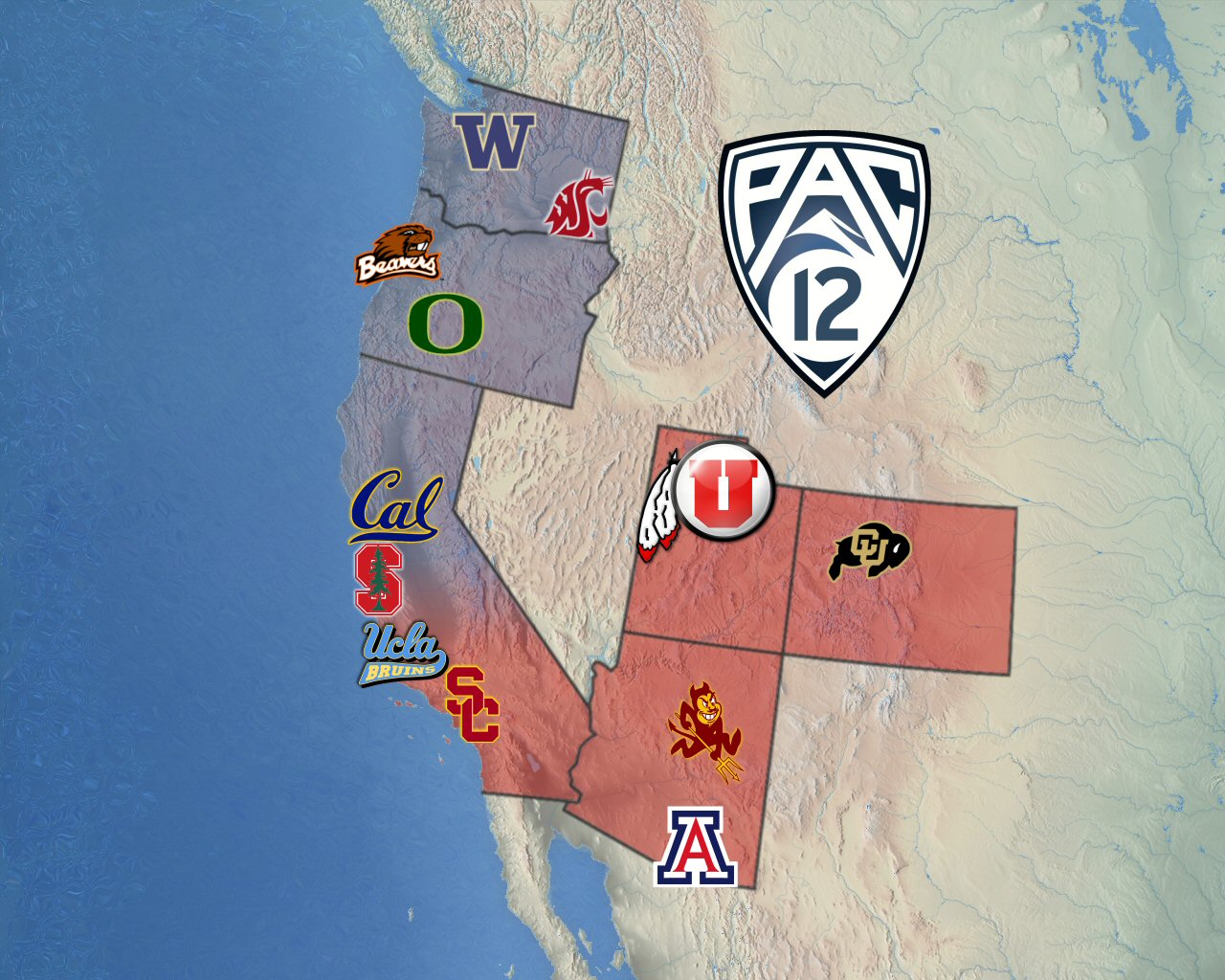
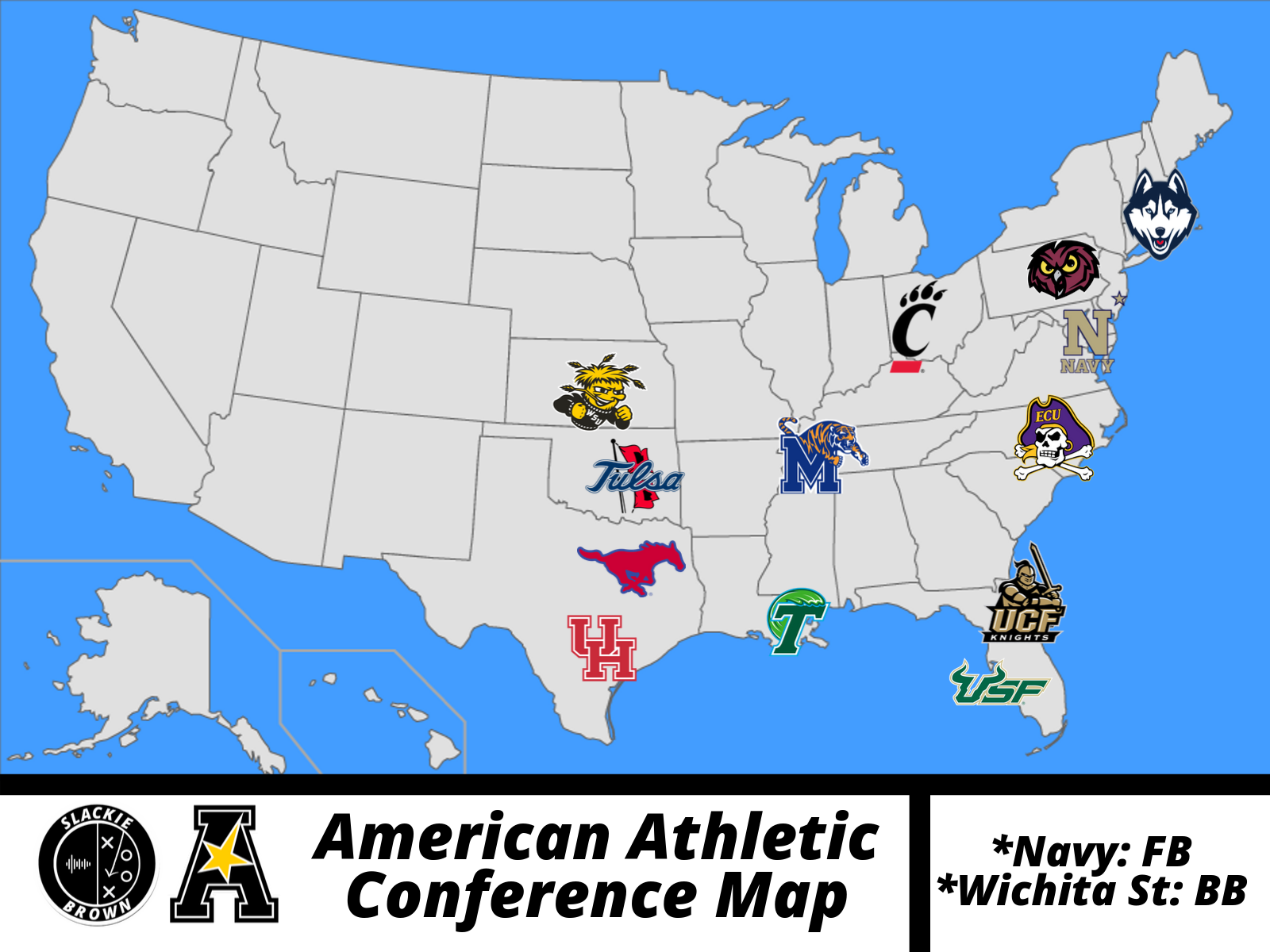
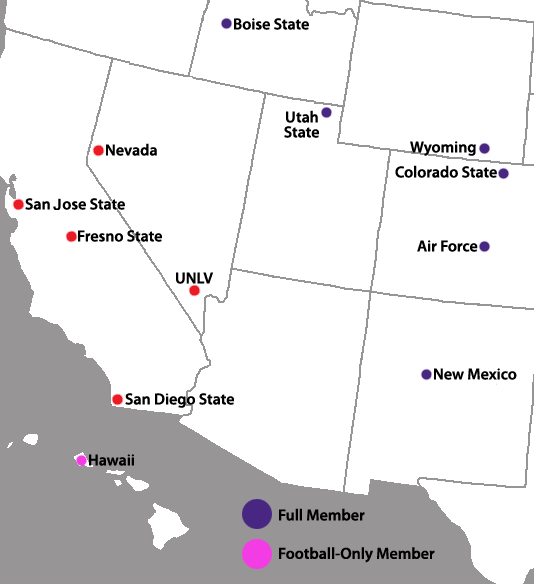
There are 130 teams in the FBS in 2020, most of them aligned with 10 conferences. You really should click on that link. It gives a Google Map that someone created with the location of every single team with conference alignment. Here are the teams, by conference size:



/cdn.vox-cdn.com/uploads/chorus_asset/file/9294521/Sunbelt_2016.png)

Doing the math, that’s a total of 124 teams. That leaves the six “Independents”: BYU (Utah), Notre Dame (Indiana), Liberty (Virginia), Army (New York), Massachussetts (Duh), and New Mexico State (Double Duh).
The map below shows almost every single team in the country. For some reason, Liberty and Coastal Carolina are omitted and Idaho is shown even though they are now an FCS team. New Mexico State is also mislabeled as a member of the Sun Belt conference. I suggest you click on it and pop it out to make it bigger and so you can play with it to your heart’s content. Dick joke.
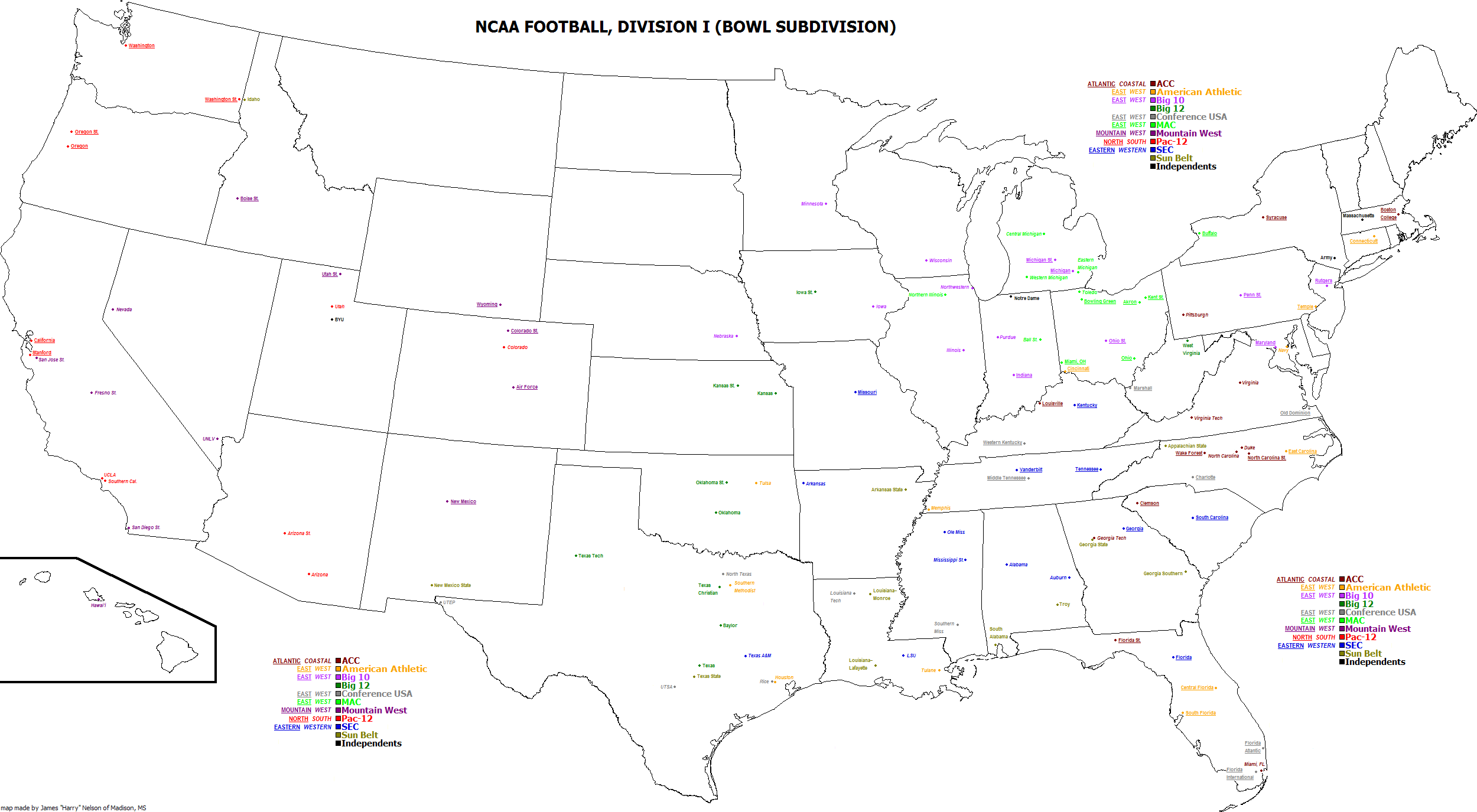
I should note that the University of Connecticut will leave the AAC and become a football independent for the 2020 season. There is no word yet as to whether the AAC will stay at 11 teams or try to get a 12th team for football. Frankly, any team they pick up will be better than UConn at football.
***
Ok, let’s get to the meat of this post. How do we crown a true National Champion?

The first thing that needs to happen is for the champions of all conferences to be included in the playoff field. That takes care of 10 teams. We need another 6 to round out the field and make it a 16 team single-elimination tournament. We will need a points system to determine who else gets to go.
I present to you the Balls’ Point System for FBS (patent pending)!
First, all teams will need to play the same number of games so it’s an even playing field. We will need to institute the following rules:
- Each FBS team plays a total of 11 regular season games
- There will be 8 conference games and 3 non-conference games
- Each team will play each team in its division once with home teams rotating every year.
- The remainder of the conference games will be rotated amongst the teams in the other divisions.
- For the Big 12, which has only 10 teams and no divisions, one team will be left out of the schedule on a rotating basis each year. Alternatively, it can form divisions and follow the others.
- Rivalry Games will be maintained even if they are with non-conference teams (Example: Iowa-Iowa State) or non-division teams (Example: Purdue-Indiana) and the home team will change each year. This may take up one of the non-conference matchups or one of the non-divisional conference games.
- For a Rivalry game to be considered a “Rivalry Game”, the teams must meet annually with rotating home games and one team cannot have a winning percentage above 70% against the other. Also, both teams have to agree that they are “Rivals”. Example: USC must choose either UCLA or Notre Dame to be its “Rival”. It can’t be both and the other school must choose it as its “Rival”.
- Each team will have a maximum of 6 home games.
Points will be awarded as follows:
- Conference Win = 4 points
- Non-Conference Win = 2 points
- Rivalry Game Win = 1 point bonus
- Road Win = 1 point bonus (Note: Neutral site games are considered road games for both teams)
- Overtime Loss = 1 point
- Loss = 0 points
Teams will not be allowed to schedule games against FCS teams. Until the schedule fades them out, a win against a FCS team will count for 0 points.
***
The 6 teams to join the conference champions in the playoff will be the teams with the highest point total amongst all 130 teams not already a conference champion.
Point tie-breakers will be as follows:
- Head-to-head (two teams only)
- Non-conference record
- Road Wins
- Draw
***
Playoff Draw
- The 10 conference champions will be placed into Pot A
- The 6 at-large teams will be placed into Pot B.
- Eight teams from Pot A will be drawn into each of the eight Round of Sixteen games as the “home” teams.
- The Six teams in Pot B will be drawn into the Round of Sixteen games as the “visiting” teams. If the “home” team is from the same conference, the team will be drawn into the next matchup.
- The remaining two teams in Pot A will be drawn into the remaining Round of Sixteen games as the “visiting” teams.
After the Round of Sixteen Games, the winners are put into Pot C to determine the quarterfinal matchups. The first four teams drawn are the “home” teams while the next four teams are the “visiting” teams.
For the semifinals, the seedings remain from the quarterfinal matchups. The determination of “home” and “visiting” is done by coin flip.
***
There you have it. Seems simple enough, don’t you think?
Here are the 10 conference champions that would have taken part in the playoffs this year:
- Oregon (Pac 12 champion)
- LSU (SEC champion)
- Oklahoma (Big 12 champion)
- Clemson (ACC champion)
- Ohio State (Big 10 champion)
- Memphis (AAC champion)
- Florida Atlantic (Conference USA champion)
- Miami of Ohio (MAC champion)
- Appalachian State (Sun Belt champion)
- Boise State (Mountain West champion)
The remaining six cannot be determined exactly at this time because my system is not set up yet (teams play a different number of games and “Rivals” haven’t been officially determined), but here is a table showing the highest non-champion Top 25 teams and their approximate point totals using my system without counting Rivalry Game points:
| AP Rank | Team | Balls Points |
| 5 | Georgia | 42 |
| 6 | Florida | 35 |
| 8 | Baylor | 43 |
| 9 | Alabama | 35 |
| 9 | Auburn | 31 |
| 11 | Wisconsin | 37 |
| 12 | Utah | 44 |
| 13 | Penn State | 37 |
| 14 | Notre Dame | 23 |
| 16 | Minnesota | 35 |
| 17 | Michigan | 33 |
| 19 | Iowa | 33 |
| 21 | Navy | 37 |
| 22 | USC | 33 |
Going by that, the other six teams in my Balls Championship would be:
- Utah (Pac 12 Championship Game Loser)
- Baylor (Big 12 Championship Game Loser)
- Georgia (SEC Championship Game Loser)
- Navy
- Penn St.
- Wisconsin (Big 10 Championship Game Loser)
I think that’s a pretty good field, don’t you think?
Your thoughts, as always, in the comments.
(140/69)






Leave a Reply
You must be logged in to post a comment.